

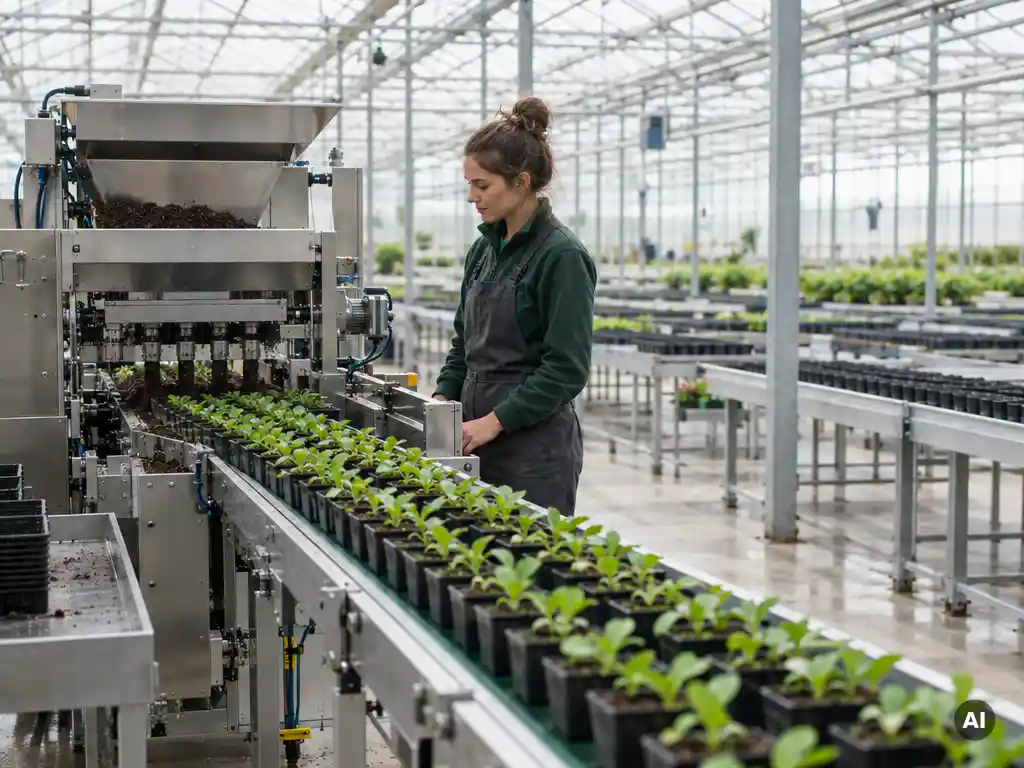
Why greenhouse efficiency is the answer to unfilled nursery vacancies
Every grower knows the feeling: the vacancy has been open for months, the seasonal peak is approaching, and the same few people are carrying more crates, pots and trays than any team should. Greenhouse efficiency is no longer a nice extra for nurseries. It is the most practical answer to a labor market that simply is not going to deliver enough hands.
Instead of waiting for the perfect candidate to apply, more nursery owners are asking a different question: how can the same output be reached with fewer people? The answer usually starts with internal transport, and it is more approachable than many growers expect.
The Hidden Cost of Open Positions
An unfilled vacancy costs far more than the salary you are not paying. The real price shows up in overtime, expensive temporary staff, slower throughput and the fatigue of the people who stay.
When a position stays open for months, the work does not disappear. It gets spread over the existing team, which raises sick leave and turnover, especially in physically demanding roles. Seasonal peaks then force growers to bring in temps who need training, make more mistakes and leave again after a few weeks.
Meanwhile, wages keep rising and margins keep shrinking. Competitors who have already automated can produce faster and cheaper, which puts extra pressure on nurseries that still rely on manual handling for every step.
Where Greenhouse Labor Is Wasted Today
Most wasted labor in a nursery sits in internal transport: moving plants, trays and pots from one workstation to the next by hand or by cart.
Walk through a typical potting or packing line and you will see people who are paid to handle plants but spend a large part of their day carrying, stacking, pushing and waiting. None of these movements add value to the product. They simply connect one task to the next.
Common examples include:
- Carrying trays between the potting machine and the buffer area
- Manually feeding and clearing workstations during peak hours
- Moving plants over long distances inside the greenhouse or packing hall
- Waiting time caused by uneven flow between stations
Each of these tasks looks small on its own. Added together over a full season, they represent a large share of your payroll, and they are exactly the tasks that automation handles best.
Automation Solutions That Replace Manual Handling
The most effective way to improve greenhouse efficiency is to let machines handle the repetitive transport and let people focus on tasks that actually need human judgment.
Several building blocks work together here. Conveyor belts move products between stations without anyone having to carry them. Buffer tables smooth out the flow so a slow moment at one station does not stall the whole line. Potting machines and watering stations take over steps that used to need several people, and roller conveyors handle heavier loads with minimal effort.
What makes this approach practical is that the components can be combined. Add work tables, scales or lighting where needed, and a series of separate tasks becomes one smooth production line. The result is a more ergonomic workplace, fewer repetitive strain injuries and a process that keeps its pace even when staffing is tight.
Starting Small With Rental and Mobile Belts
You do not need to rebuild your entire nursery to start saving labor. A single mobile conveyor belt, or a rental during your busiest weeks, is often enough to prove the concept.
This step-by-step route lowers the threshold considerably. Many growers begin by renting equipment for a seasonal peak, see how much time and effort it saves, and only then decide where fixed systems make sense. There is no big upfront bet on something you have never tried in your own greenhouse.
From there, growth is natural. A mobile belt becomes a permanent line, a buffer table is added where bottlenecks appear, and the system expands in the places where it pays off most. We build and install these solutions ourselves, so hardware, software and installation come from one source instead of three different suppliers.
From 26 to 6 FTE: Real Results
When internal transport is automated thoroughly, the effect on staffing can be dramatic. One of our customers went from 26 to 6 FTE for the same output.
That is not a story about cutting corners. It reflects how much of the original workforce was tied up in moving products rather than growing or finishing them. Once belts, buffers and machines took over the transport, the remaining team could work faster, with less strain and fewer errors.
Not every nursery will see the same ratio, since results depend on layout, product mix and current processes. But the direction is consistent: fewer people needed, higher output per person and a business that depends less on a labor market that cannot meet demand. For growers who struggle to fill vacancies, that independence is worth as much as the cost savings.
Common Automation Mistakes to Avoid
Most automation projects that disappoint do so for avoidable reasons, usually related to scope, planning or the order in which things are done.
A few pitfalls come up again and again:
- Automating everything at once. A big-bang approach is risky and expensive. Starting with the biggest bottleneck gives faster proof and easier adoption.
- Ignoring the process. Putting a belt in the wrong place only moves the problem. The flow of the whole line should be reviewed first.
- Buying from too many suppliers. Separate vendors for hardware, software and installation often mean gaps in responsibility when something does not work together.
- Skipping the trial. Testing with mobile or rental equipment shows what really works in your greenhouse before you commit to fixed systems.
- Forgetting the team. Involving the people who work on the line makes the new setup smoother and more readily accepted.
The good news is that none of these mistakes are hard to avoid with the right preparation. If you are unsure where to begin, get in touch with us and we will discuss the best first step for your nursery. Open vacancies may stay open, but your greenhouse does not have to wait for them.
Frequently Asked Questions
How do I figure out where to start automating in my nursery?
Begin by observing your line for a few days and noting where people spend time carrying, stacking, pushing or waiting rather than handling plants. The station with the most manual transport or the one that regularly creates a bottleneck is usually the best first candidate. Involve the employees who work there, since they know exactly where time gets lost, and review the flow of the whole line before placing any equipment.
What if my greenhouse layout is cramped or irregular? Can conveyor systems still work?
Yes. Conveyor belts, roller conveyors and buffer tables are modular, so they can be configured in straight lines, corners or compact layouts to fit the space you have. Mobile belts are especially useful in tight or irregular spaces because you can reposition them as needed. A site visit to measure the space and map the product flow will show what is realistic before you invest.
How can I test automation without a big upfront investment?
Rent a mobile conveyor belt for your busiest weeks or a seasonal peak and measure the results. Track things like the number of people needed at a station, trays handled per hour and overtime before and after. If the numbers show a clear gain, you have solid evidence to justify expanding to a fixed system.
Will automation mean I have to lay off my existing staff?
Not necessarily. For most nurseries the main goal is to fill the gap left by vacancies you cannot fill and to reduce reliance on expensive temporary workers. Existing employees can move from heavy carrying and repetitive tasks to work that needs judgment, such as quality control, plant care and operating the machines. This also tends to lower physical strain and sick leave, which helps you keep good people.
How do I know if the result I can expect is realistic, given the 26 to 6 FTE example?
That example shows what is possible when internal transport is automated thoroughly, but the outcome depends on your layout, product mix and how much of your current workforce is tied up in moving products. A good way to estimate your own potential is to calculate how many hours per day are spent on pure transport and buffering. Even if your savings are smaller, reducing those hours usually pays off through less overtime, fewer temps and a steadier pace.
What should I prepare before talking to an automation supplier?
Gather a simple overview of your current process: the product types and tray or pot sizes, volumes in peak and off-peak periods, the number of people at each station, and a rough floor plan or photos of the area. Also note your biggest pain points, such as specific bottlenecks or tasks that are hard to staff. The more concrete your input, the easier it is to propose a practical first step instead of a generic solution.
Why is it better to work with a single supplier for hardware, software and installation?
When one party is responsible for the whole system, there are no gaps in responsibility if components do not work well together. Troubleshooting is faster because there is a single point of contact, and the system is designed as one coherent line instead of a patchwork. It also makes future expansion easier, since new belts, buffers or machines are built to integrate with what you already have.