
Why greenhouse efficiency suffers when heavy work drives up absenteeism
Every grower knows the feeling: a good week of production, then two or three people call in sick and the whole rhythm falls apart. Greenhouse efficiency rarely collapses because of one big problem. More often it erodes through a steady stream of small gaps, and physically demanding work is one of the main drivers behind them.
Heavy, repetitive tasks wear people down over time, and when people drop out, the rest of the operation pays the price. Understanding how that chain reaction works is the first step toward breaking it. Here is a look at the real costs, the tasks that cause the strain, and the practical ways to lighten the load.
The Hidden Costs of Sick Days in Horticulture
Absenteeism costs far more than the wages of the person who is away. Replacement labor, overtime, lost output and slower decision-making all add up, and most of these costs never appear on a single line in the books.
Consider what happens when a team member is out for a few days. Someone has to cover the gap, which usually means pulling a colleague from another task or hiring a temp who needs time to learn the routine. Temporary workers are often more expensive per hour and, in a busy season, can be hard to find at all.
Then there is the longer-term effect. Repeated absence tends to signal that the work itself is too demanding, which feeds turnover. Recruiting and training new people takes time that most family-run nurseries simply do not have, and vacancies can stay open for months. Over a year, that quiet drain on productivity and margin can outweigh many of the more visible expenses.
Which Greenhouse Tasks Strain Workers Most
The tasks that strain workers most are those that combine lifting, carrying and repetition, especially when they happen all day long. In potted plant and ornamental production, that means moving trays, pots and containers by hand from one station to the next.
Lifting and carrying
Carrying full trays across long distances is a classic culprit. A single lift may seem harmless, but hundreds of them per shift put steady pressure on the back, shoulders and knees. Over months and years, this is exactly how minor aches turn into extended sick leave.
Repetitive handling and awkward postures
Potting, sorting and loading often require bending, twisting and reaching in the same motion again and again. Workstations that are too low or too far away make it worse. Even lighter tasks become a problem when the posture is wrong and the pace never lets up.
These strains also hit hardest during peak periods, when the pressure to keep up is highest and recovery time is shortest. That is precisely when a single absence is felt most sharply across the whole operation.
How Absenteeism Spreads Through Your Workflow
Absenteeism spreads because greenhouse processes are connected: when one station slows down, everything before and after it feels the delay. A gap at the start of the line creates idle time downstream, while a gap at the end creates a backlog upstream.
Imagine a potting line with one person missing. The remaining team members either speed up, which raises the risk of mistakes and injury, or the line slows to match the reduced capacity. Neither option is good for greenhouse efficiency, and both put extra load on the people who showed up.
This is where a vicious circle begins. Colleagues who cover for absent teammates carry more physical load, which increases their own risk of getting sick. Quality can slip too, with rushed handling leading to damaged plants and rework. What started as one missing person becomes a pattern that affects delivery times, customer satisfaction and morale.
Automating Internal Transport to Lighten the Load
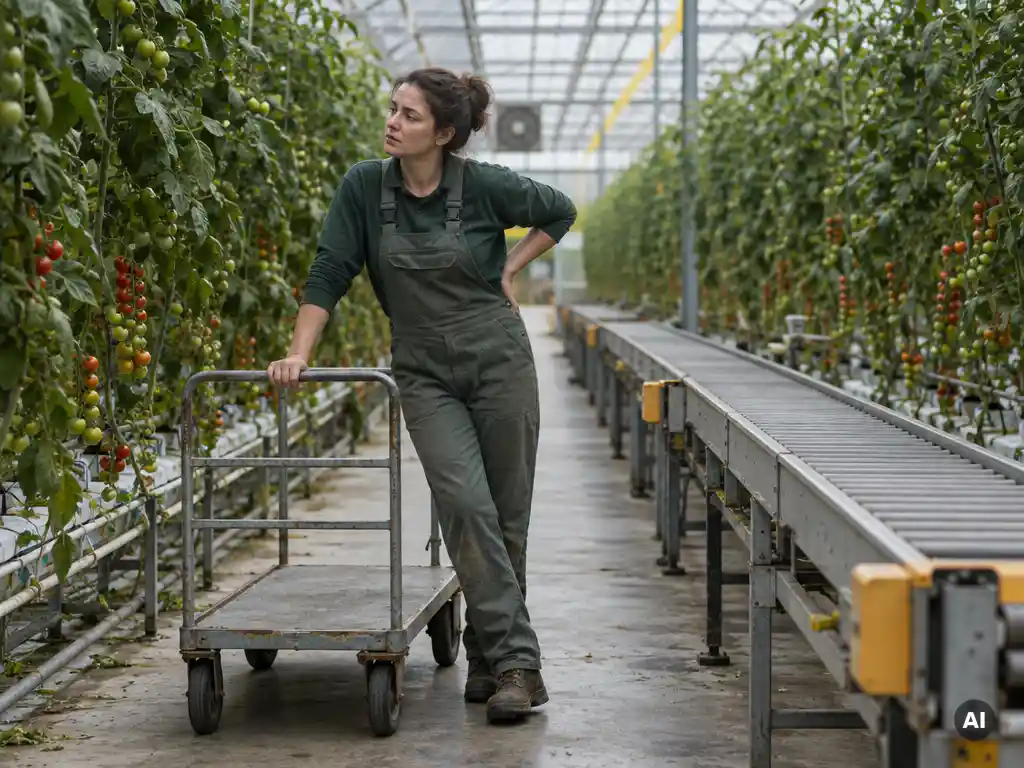
Automating internal transport removes the heaviest and most repetitive part of the job: moving goods by hand. Conveyor belts, buffer tables, roller tracks and potting machines take over the carrying, so people can focus on tasks that actually need human skill.
The benefit is twofold. Physical strain drops, which supports healthier, more sustainable work and fewer sick days. At the same time, the flow of material becomes steadier and more predictable, which makes the whole process less sensitive to a single absence.
At MartinStolze, we have spent more than 30 years building these solutions in our own workshop in De Lier, specifically for horticulture and greenhouse operations. Our products are designed to combine with each other and can be fitted with work tables, scales and lighting, so a line can be shaped around how your team actually works. Some of our customers have gone from 26 to 6 FTE for the same output, showing how much capacity can be freed up when transport is automated. You can see what is possible in our range of conveyor belts.
A Step-by-Step Route From Mobile to Fixed Systems
The most practical route is to start small with a mobile conveyor belt and grow toward fixed systems as results come in. This keeps the first investment low and lets a team experience the benefits before committing to a larger setup.
Many growers begin by renting equipment during a peak period. That gives a real-world test: does the belt reduce carrying, does the team like working with it, and where are the next bottlenecks? Those answers guide the next step far better than any spreadsheet can.
From there, the setup can expand in stages. A mobile belt might be followed by buffer tables to smooth out the flow, then a potting machine, and eventually a fully integrated fixed line that forms the backbone of production. Because hardware, software and installation come from one supplier, there is no need to coordinate between several parties along the way.
The best moment to start is before the next busy season, not in the middle of it. If you are unsure where to begin, we are happy to think with you about your layout and priorities. Get in touch with our team and we will help you find a first step that fits your nursery in 2026.
Frequently Asked Questions
How do I figure out which tasks in my greenhouse are causing the most strain and absenteeism?
Start by walking the production line and noting every point where people lift, carry, bend or twist repeatedly. Then compare this with your sick-leave records and ask your team directly where they feel the most discomfort. Tasks with high repetition, long carrying distances or poorly positioned workstations are usually the first candidates for improvement.
How can I estimate the real cost of absenteeism in my nursery?
Add up more than just wages: include temporary labor, overtime, lost or delayed output, rework from rushed handling, and the time spent recruiting and training replacements. Track these for a few months using a simple spreadsheet, then divide by the number of sick days. The result is usually much higher than growers expect and makes it easier to judge the payback of automation.
Is renting a mobile conveyor belt really a good way to get started?
Yes, renting during a peak period lets you test whether the belt reduces carrying, fits your layout and is accepted by your team, without a large upfront investment. Pick a task with a lot of manual transport, such as moving potted plants between stations, and measure the time and effort before and after. Those results will show you where to invest next.
What if my greenhouse layout is tight or irregular? Can automation still work?
In most cases, yes. Modular systems such as conveyor belts, buffer tables and roller tracks can be combined and customized with different lengths, heights and add-ons to fit the space you have. Sharing a simple sketch or photos of your layout with your supplier is a good first step toward a workable design.
How do I get my team on board with new equipment?
Involve your employees early by asking where the work is most tiring and letting them try a mobile system before any permanent decisions are made. Emphasize that the goal is to remove heavy, repetitive tasks, not to replace people. When staff see less strain and a steadier workflow, acceptance usually follows quickly.
What are common mistakes when automating internal transport?
The most frequent mistakes are starting during the busiest season, automating a single station without considering the bottlenecks upstream and downstream, and buying from several suppliers whose systems do not fit together. Plan the change before peak season, think in terms of the whole flow, and choose compatible components so you can expand step by step.
Besides automation, what else can reduce physical strain in a greenhouse?
Adjust workstation heights so people can work without bending or reaching, add scales and good lighting to reduce awkward postures, and rotate tasks so nobody does the same heavy motion all day. Short recovery breaks during peak periods also help. These measures work best combined with automated transport, which removes the heaviest part of the job.