
Why is internal transport so important in horticulture?
Efficient internal transport is one of the most overlooked factors in horticultural productivity. While growers focus heavily on crop quality, irrigation, and climate control, the way plants and products move through a facility has an enormous impact on labour costs, employee well-being, and overall throughput. Understanding the role of conveyor belt horticulture systems and internal transport solutions is increasingly essential for any nursery or distribution centre looking to stay competitive.
This article answers the most common questions growers and operations managers ask when evaluating their internal transport setup, from basic definitions to practical investment decisions.
What is internal transport in horticulture?
Internal transport in horticulture refers to all the systems and processes used to move plants, pots, trays, and growing media within a nursery, greenhouse, or distribution centre. This includes everything from moving freshly potted plants to a growing area to transporting finished products to a packing station and delivering soil or substrate to potting machines.
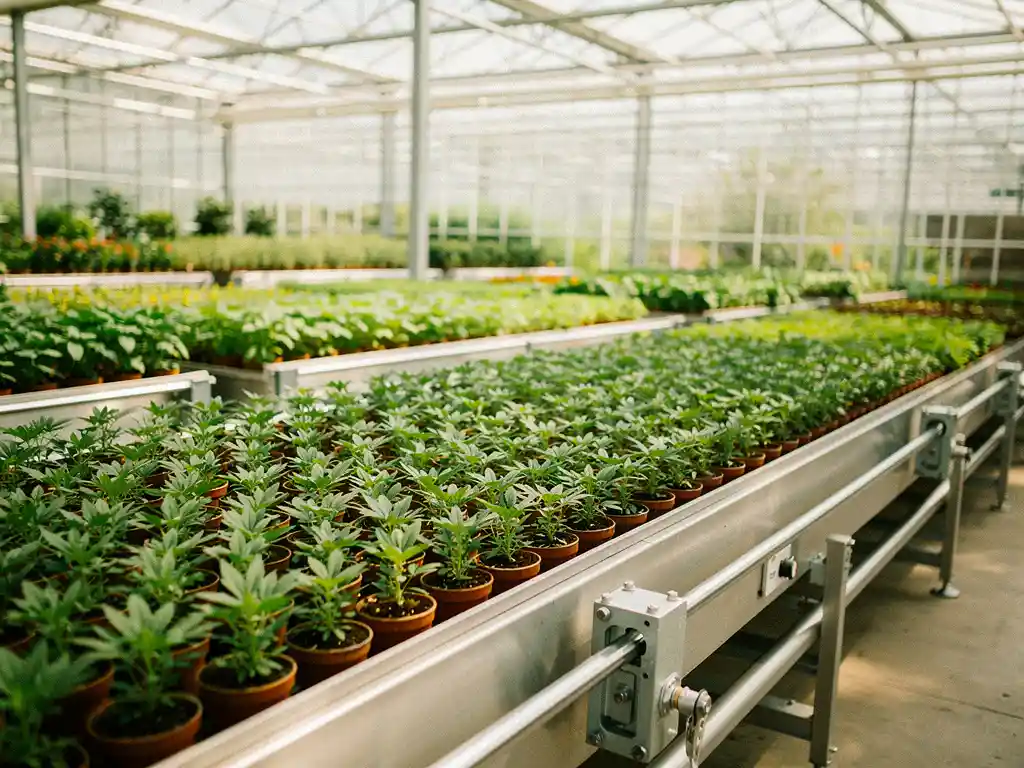
In practice, internal transport covers a broad range of activities. Plants may need to travel from a propagation area to a greenhouse bay, from a growing bench to a sorting line, or from a packing station to a loading dock. In larger operations, these movements happen hundreds or thousands of times per day. The systems used to facilitate this movement include conveyor belts, roller conveyors, buffer tables, ground conveyors, and elevator belts, all of which can be combined into continuous transport lines tailored to a specific facility layout.
What sets horticultural internal transport apart from general industrial logistics is the environment. Greenhouses are humid, often muddy, and require equipment that can handle organic material, varying pot sizes, and delicate plant stock without causing damage. This is why purpose-built horticultural transport systems differ significantly from standard industrial conveyor solutions.
Why is internal transport so important in horticulture?
Internal transport is important in horticulture because it directly determines how efficiently labour, time, and space are used across the entire production process. Poor transport flow creates bottlenecks, increases physical strain on workers, and slows down throughput, all of which translate into higher costs and lower output capacity.
Horticulture is a labour-intensive industry where margins are often tight. The time workers spend physically carrying or wheeling plants from one point to another is time not spent on value-adding tasks like potting, grading, or packing. In large nurseries, employees can walk several kilometres per shift simply moving product, which adds up to significant lost productivity over a growing season.
Beyond productivity, internal transport affects the consistency and quality of operations. A well-designed transport system creates a steady, predictable flow of product through the facility, which makes it easier to plan staffing, manage peak periods, and maintain quality standards. When transport is unreliable or overly dependent on manual handling, the entire production rhythm becomes unpredictable.
What problems does manual plant transport cause?
Manual plant transport causes three core problems: excessive labour costs, physical strain leading to absenteeism, and uneven production flow. Together, these issues reduce operational efficiency and make it difficult to scale production without proportionally increasing headcount.
The physical demands of manual transport are significant. Repeatedly lifting, carrying, and pushing heavy loads of plants or growing media puts enormous strain on workers’ backs, shoulders, and joints. Over time, this leads to musculoskeletal complaints, increased sick leave, and higher staff turnover, all of which create both human and financial costs for the business.
From a production flow perspective, manual transport introduces variability. Workers move at different speeds, take breaks at different times, and can only carry a limited number of plants per trip. This creates queues and waiting times at key points in the production line, such as potting machines or packing stations, where one slow link causes the entire process to stall.
There is also a scaling problem. As a nursery grows, manual transport does not scale efficiently. Doubling output often requires more than doubling the workforce dedicated to moving product, which erodes the economics of growth. Automated transport, by contrast, scales far more linearly with production volume.
How does conveyor belt automation improve horticultural operations?
Conveyor belt automation improves horticultural operations by creating a continuous, consistent flow of product through the facility without relying on manual labour for transport. This reduces walking time, eliminates bottlenecks, decreases physical strain, and allows workers to focus on skilled tasks rather than moving product from point to point.
When a conveyor belt system connects different stages of production, such as potting, growing, sorting, and packing, the entire line operates at a controlled, consistent pace. Workers at each station receive product at a steady rate, which makes it easier to maintain quality and predict output. This kind of flow-based production is far more efficient than the stop-start rhythm that characterises manual transport operations.
Conveyor belts designed for horticulture also contribute to better ergonomics. When plants arrive at the right height and position for each task, workers spend less time bending, reaching, and lifting awkwardly. This reduces injury risk and makes physically demanding jobs more sustainable over a full working day.
We design and produce conveyor belt systems specifically for the horticultural sector, built from robust materials that withstand moisture, soil, and the demanding conditions of greenhouse environments. Because all our systems are mutually compatible, they can be combined into complete production and transport lines, integrated with potting machines, sorting systems, and packing stations from a single source.
What types of internal transport systems exist for nurseries?
Nurseries can choose from several types of internal transport systems, each suited to different tasks and facility layouts. The main categories are mobile conveyor belts, fixed conveyor belts, buffer belts, roller conveyors, ground conveyors, and elevator belts.
- Mobile conveyor belts are flexible, freestanding units that can be repositioned as needed. They are ideal for operations where transport needs change seasonally or where a permanent installation is not yet justified. Examples include units designed for use between greenhouse bays or alongside potting areas.
- Fixed conveyor belts form the backbone of permanent transport lines, connecting fixed workstations in a continuous flow. They are best suited to facilities with stable, high-volume production processes.
- Buffer belts and buffer tables act as temporary storage points within a line, absorbing differences in speed between upstream and downstream processes to prevent bottlenecks.
- Roller conveyors allow product to move along a series of rollers, often by gravity or gentle propulsion, and are well suited to packing and sorting areas.
- Ground conveyors transport growing media, soil, and substrate to potting machines, removing the need for manual filling and reducing mess and waste.
- Elevator belts move product vertically between different levels within a facility, enabling multi-level production layouts.
The right combination depends on the specific layout, production volume, and workflow of each individual operation. Many nurseries use a mix of mobile and fixed systems to balance flexibility with efficiency.
When should a nursery invest in transport automation?
A nursery should invest in transport automation when the cost and inefficiency of manual transport begin to outweigh the investment required to replace it. Key indicators include high labour costs tied to transport tasks, recurring physical complaints among staff, frequent bottlenecks in the production line, and plans to scale production capacity.
There is no single threshold that applies to every operation, but certain signals consistently point toward readiness for automation. If workers are spending a significant portion of their shift walking between stations rather than performing skilled tasks, the labour cost alone often justifies the investment within a relatively short period. Similarly, if absenteeism due to physical strain is a recurring issue, automation delivers both a financial and a human benefit.
For operations that are uncertain about committing to a permanent system, rental is a practical starting point. Renting a mobile conveyor belt allows a nursery to experience the productivity gains of automated transport in its own environment before making a capital investment. This reduces risk and provides concrete operational data to inform a larger decision.
Ultimately, the best time to invest in transport automation is before growth creates a crisis. Waiting until manual transport becomes completely unmanageable means losing productivity and competitive ground in the meantime. Planning automation as part of a growth strategy, rather than as a reactive fix, delivers the greatest long-term return.
Frequently Asked Questions
How do I calculate the return on investment for a conveyor belt system in my nursery?
Start by calculating your current transport-related labour costs — estimate the hours per shift spent moving product, multiply by your hourly labour rate, and project that across a full season. Then factor in indirect costs like absenteeism, staff turnover, and lost throughput at bottleneck points. Compare this total against the purchase or rental cost of the system, including installation. Most nurseries find that a well-matched conveyor system pays for itself within one to three growing seasons, particularly in high-volume operations where labour costs are the dominant variable.
Can conveyor belt systems handle different pot sizes and plant types without damaging delicate crops?
Yes — purpose-built horticultural conveyor systems are specifically designed to accommodate a range of pot sizes, tray formats, and plant types, including fragile or top-heavy specimens. Belt speed, surface material, and side guides can all be adjusted to suit the product being transported. Unlike standard industrial conveyors, horticultural systems use gentler belt surfaces and configurable spacing to minimise tipping, bruising, or stem damage. If your operation handles a particularly wide variety of pot sizes or sensitive crops, it is worth discussing this with your supplier during the design phase so the system can be tailored accordingly.
What maintenance does a horticultural conveyor system typically require?
Horticultural conveyor systems require relatively straightforward routine maintenance, including regular cleaning to remove soil, organic debris, and moisture build-up, periodic inspection of belt tension and roller alignment, and lubrication of moving parts according to the manufacturer's schedule. Because greenhouse environments are humid and expose equipment to soil and organic material, using systems built from corrosion-resistant materials significantly reduces long-term maintenance demands. Building a simple weekly and monthly maintenance checklist into your operations routine is usually sufficient to keep systems running reliably and extend their service life.
Is it possible to integrate conveyor systems with existing potting machines or packing equipment we already have?
In most cases, yes — conveyor systems can be designed or configured to interface with existing potting machines, sorting lines, and packing stations, even if they were sourced from different suppliers. The key is to ensure that belt heights, speeds, and feed rates are matched to the input and output specifications of your existing equipment. Working with a supplier that has experience integrating transport systems within complete production lines will help identify any compatibility issues early. Where a perfect mechanical fit is not possible, buffer belts or transition tables can bridge the gap between systems effectively.
What is the difference between renting and buying a conveyor system, and which makes more sense for a smaller nursery?
Renting is the lower-risk entry point — it requires minimal upfront capital, allows you to test the system in your own facility, and gives you flexibility if your production layout or volume changes. Buying makes more sense once you have confirmed that the system delivers the expected productivity gains and that your production processes are stable enough to justify a permanent installation. For smaller nurseries or those with seasonal peaks, starting with a rental of one or two mobile conveyor belts is a practical way to build the operational evidence needed to make a confident capital investment decision later.
How long does it typically take to install a fixed conveyor system, and will it disrupt ongoing production?
Installation timelines vary depending on the complexity and scale of the system, but a straightforward fixed conveyor line connecting two or three workstations can typically be installed within one to a few days. More extensive, multi-zone systems may require a longer installation window. To minimise disruption, many operations schedule installation during a quieter production period, such as between growing cycles or during a planned maintenance shutdown. Working closely with your supplier to map out an installation plan in advance — including phasing where possible — can significantly reduce the impact on day-to-day operations.
What common mistakes should nurseries avoid when planning their internal transport layout?
The most common mistake is designing a transport system around the current facility layout rather than around the optimal production flow. This often results in systems that move product efficiently in one area but create new bottlenecks elsewhere. Other frequent pitfalls include underestimating future production volume and installing a system that becomes a constraint within a few years, neglecting to include buffer capacity between process stages, and failing to involve the workers who will use the system in the planning process. Taking the time to map your full production flow from start to finish before specifying any equipment will save significant cost and rework down the line.
Related Articles
- How do you design an efficient potting and topping line?
- How does a topping machine work in a pot plant production line?
- How does material particle size affect topping machine performance?
- At what hourly production target does automation become necessary?
- Why do breakdowns always seem to happen at the worst moment?