

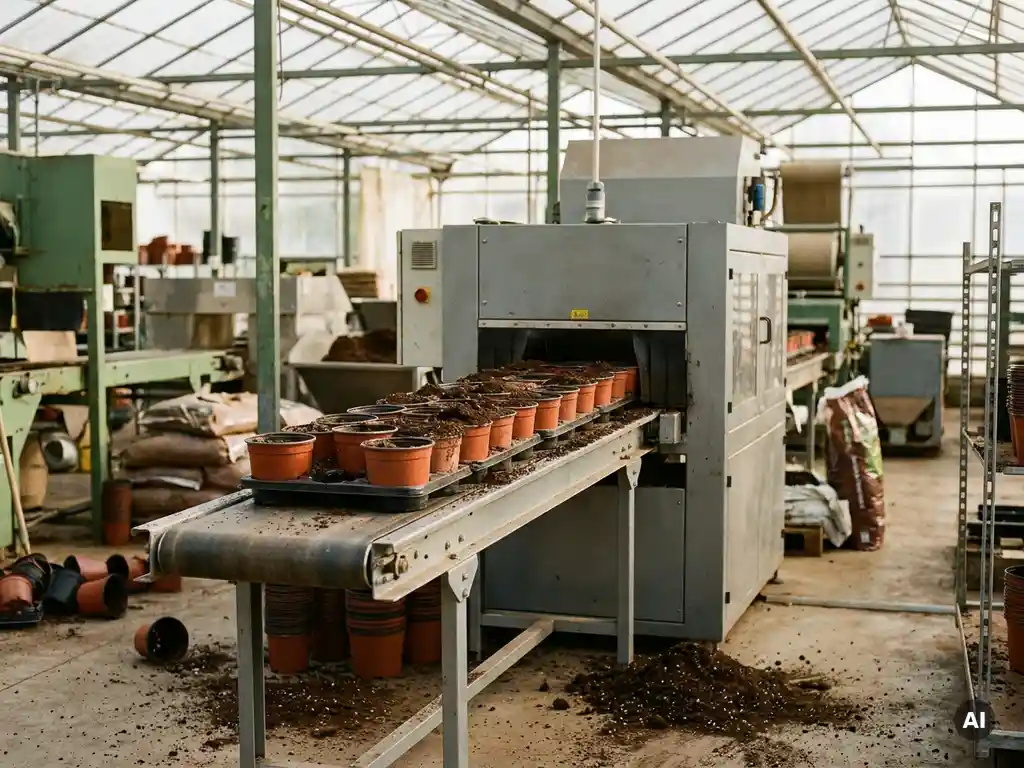
Why is real production output often lower than the advertised pots per hour?
Real production output from a potting machine is almost always lower than the advertised pots-per-hour figure. The rated capacity represents the machine running under ideal, controlled conditions, consistent soil, perfectly sized pots, and no interruptions. In real nursery environments, a combination of soil mix variability, operator workflow, and machine setup typically reduces effective throughput by 20 to 40 percent. The sections below unpack exactly why this gap exists and what you can do to close it.
What factors cause actual potting speed to drop below spec?
Actual potting speed drops below the rated spec because the advertised figure assumes continuous, uninterrupted operation with optimal inputs. In practice, several variables break that assumption: soil bridging in the hopper, pot misfeeds, tray changeovers, brief pauses for quality checks, and the simple reality that operators need to reposition trays, clear jams, or adjust settings. Each pause, even a short one, chips away at the hourly total.
The most common culprits include:
- Soil mix inconsistency: Wet, fibrous, or coarse substrates clog or slow the auger, reducing fill speed and causing uneven pot weights.
- Pot size changes: Switching between pot diameters mid-shift requires reprogramming and physical adjustments, creating downtime.
- Operator pace and positioning: Even with a well-designed machine, the human element introduces variation, especially when staff are new or fatigued during peak season.
- Downstream bottlenecks: If the conveyor or sorting line cannot keep pace, the potting machine must slow down or stop entirely to avoid backlog.
- Maintenance interruptions: Older or less robust machines may require mid-shift cleaning, belt adjustments, or sensor resets.
Understanding these factors is the first step toward realistic capacity planning. A machine that runs at 6,000 pots per hour for 50 minutes of every 60 delivers far more value than one rated at 8,000 that stops regularly.
How is pots-per-hour capacity actually measured by manufacturers?
Manufacturers measure pots-per-hour capacity under controlled benchmark conditions, not in a working nursery environment. The test typically uses a single, consistent pot size, a free-flowing dry or lightly moist substrate, and a machine running at its maximum programmed speed without interruption. The result is the mechanical ceiling, the fastest the machine can physically cycle.
This is a legitimate and useful number because it allows direct comparison between machines. But it is not a production forecast. The benchmark does not account for the time needed to load trays, clear minor jams, adjust fill depth between batches, or the natural rhythm of a working crew. Manufacturers are not being deceptive by publishing these figures, they are describing what the machine can do at its peak, not what a nursery will average across a full shift.
When evaluating a potting machine, ask the manufacturer or supplier for guidance on realistic sustained output with your specific soil mix and pot range. A knowledgeable supplier will be able to give you an honest adjusted estimate rather than just repeating the headline number.
Does soil mix type affect how many pots a machine can fill per hour?
Yes, soil mix type has a significant effect on potting machine output. A free-flowing, uniformly textured substrate allows the auger and dosing mechanism to operate at full speed with consistent fill weights. Mixes that contain high proportions of perlite, coarse bark, or long-fibre peat tend to bridge in the hopper, flow unevenly, and require slower auger speeds to maintain fill accuracy.
Moisture content matters equally. Soil that is too dry can create dust and bridging; soil that is too wet clumps and sticks to the auger and pot walls, slowing the cycle and producing inconsistent compaction. The sweet spot varies by mix, and operators often need to adjust machine settings seasonally or even batch by batch.
Some machines handle substrate variation better than others. Automatic soil detection, as found in advanced machines like the Stolze 3030 PRO, compensates for fill inconsistencies in real time, maintaining pot quality even when the mix is not perfectly uniform. This reduces the speed penalty that variable substrates would otherwise impose.
What’s the difference between peak capacity and sustained capacity?
Peak capacity is the maximum pots per hour a machine can produce in a short burst under ideal conditions. Sustained capacity is the average output maintained across a full production shift, accounting for all real-world interruptions, adjustments, and operator workflow. The gap between the two is where most nurseries lose productivity without fully realising it.
Think of peak capacity as a sprint and sustained capacity as a marathon pace. A machine rated at 8,000 pots per hour might achieve that figure for a few uninterrupted minutes, but across a full eight-hour shift the realistic average could be 5,500 to 6,500 pots per hour depending on conditions. That difference compounds significantly over a week or a season.
Sustained capacity is the number that actually determines your return on investment. When planning production schedules, staffing, and downstream logistics, always base your calculations on a conservative sustained figure rather than the peak rating. A good rule of thumb is to apply an efficiency factor of 70 to 85 percent to the advertised capacity as a starting point, then refine it based on your own substrate, pot range, and team setup.
How can a nursery close the gap between rated and real output?
Nurseries close the gap between rated and real potting output by systematically addressing each source of downtime and variability. No single fix delivers the full improvement, it requires attention to machine setup, soil preparation, operator training, and line design working together.
The most effective steps are:
- Prepare your substrate consistently: Screen and pre-mix soil to a uniform moisture level before it reaches the hopper. Reducing variability in the input reduces variability in the output.
- Pre-program settings for each pot size: Machines with touchscreen controls allow you to save profiles for different pot diameters, borehole depths, and fill volumes. Switching between jobs takes seconds rather than minutes.
- Match line speed to machine speed: Ensure your conveyor belts and downstream equipment can keep up with the potting machine at its working pace. A bottleneck anywhere in the line limits the whole system.
- Train operators thoroughly: Familiarity with the machine reduces hesitation, speeds up minor corrections, and prevents small issues from becoming full stops.
- Schedule preventive maintenance: Clean and inspect the machine at regular intervals rather than waiting for problems to appear. Machines that are well maintained run more consistently and break down less often at critical moments.
Taken together, these steps can bring real-world output much closer to the rated figure and keep it there reliably across the full season.
How MartinStolze helps you get the most from your potting machine
We design and build our potting machines in-house, which means we understand exactly how they perform across different substrates, pot sizes, and production environments. Our Stolze 3030 and Stolze 3030 PRO are built to minimise the gap between rated and real output from the ground up:
- Automatic soil detection (3030 PRO) compensates for substrate variation in real time, maintaining consistent fill quality without manual speed adjustments.
- Touchscreen programming lets operators store and recall settings for every pot size and soil combination, eliminating setup time between runs.
- Fully guided chain mechanism on the 3030 PRO delivers greater stability and quieter operation, reducing wear and maintenance interruptions.
- Seamless integration with our own conveyor systems ensures the entire production line runs at a matched pace, no downstream bottlenecks slowing the machine.
- In-house support from our own technicians and a dedicated training facility in De Lier means your team is fully prepared before production starts.
Whether you are replacing an older machine or building a new potting line from scratch, we are happy to walk through your specific situation and give you a realistic output estimate based on your substrate and pot range. Get in touch with us and we will help you plan a setup that actually delivers on its numbers.
Frequently Asked Questions
How do I calculate how many potting machines I actually need for my nursery's production targets?
Start with your daily or weekly pot target, then divide it by a realistic sustained output figure — typically 70 to 85 percent of the machine's rated capacity. For example, if you need to produce 40,000 pots per shift and a machine is rated at 8,000 pots per hour, assume a sustained output of around 5,600 to 6,800 pots per hour and plan accordingly. It is also worth building in a buffer for peak season demand, when soil variability and operator fatigue tend to push efficiency toward the lower end of that range.
What is the best way to test a potting machine's real-world output before committing to a purchase?
Whenever possible, arrange a live demonstration using your own substrate and pot sizes rather than the manufacturer's test materials. A reputable supplier will accommodate this, as it gives both parties a realistic baseline to work from. If an on-site trial is not feasible, ask the manufacturer for reference customers running a similar pot range and soil mix, and speak with them directly about the output they actually achieve in daily production.
Can the throughput gap be worse for smaller nurseries than for larger ones?
Yes, smaller operations often experience a proportionally larger gap because they tend to run more frequent pot size changes, smaller batch runs, and leaner staffing — all of which increase the share of time spent on setup and adjustments rather than active potting. Larger nurseries can amortise changeover time across longer uninterrupted runs, which keeps their effective efficiency closer to the rated figure. For smaller nurseries, investing in machines with quick-recall programming and easy adjustment mechanisms has an outsized impact on real-world output.
How often should a potting machine be serviced to maintain consistent throughput?
A daily end-of-shift cleaning routine combined with a more thorough weekly inspection of the auger, belts, sensors, and filling mechanism is a practical baseline for most nurseries. Machines running intensive seasonal schedules may need more frequent attention during peak periods. Preventive maintenance schedules provided by the manufacturer are a reliable starting point, but tracking your own machine's performance over time will reveal whether certain components need more regular attention given your specific substrate and usage patterns.
Does running a potting machine at a lower speed actually improve fill accuracy and reduce waste?
In many cases, yes. Running slightly below maximum speed gives the dosing mechanism more time to deliver a consistent fill volume, which reduces both underfilled and overfilled pots and minimises substrate waste over a full shift. The net effect on output is often smaller than expected, because the reduction in rejects and rework can offset the modest drop in cycle speed. Some advanced machines, such as those with automatic soil detection, are designed to maintain fill accuracy at higher speeds, reducing the need for this trade-off.
What downstream equipment changes have the biggest impact on overall potting line efficiency?
Conveyor belt speed matching is typically the single highest-impact change, since a conveyor that cannot keep pace with the potting machine forces the entire line to slow down or creates dangerous pot backlog. Beyond that, ensuring your tray loading and plant insertion stations are positioned ergonomically reduces operator movement time and keeps the line flowing. Integrating the potting machine and conveyor system from the same manufacturer, where possible, eliminates compatibility issues and ensures the components are designed to run at matched speeds from the outset.
Is it worth upgrading from an older potting machine if my current one still runs, just more slowly?
The case for upgrading is strongest when your older machine requires frequent mid-shift stops for cleaning or adjustment, struggles with modern substrate mixes, or lacks programmable settings that allow fast job changeovers. Even if the machine still runs, hidden costs in operator time, inconsistent pot quality, and lost throughput during peak season can add up quickly. Comparing the annual cost of those inefficiencies against the investment in a newer machine — factoring in realistic sustained output rather than rated capacity — often makes the upgrade decision straightforward.
Related Articles
- How fast should a topping machine run in a potting line?
- Can increasing pots per hour shorten your production season?
- How do short production stops affect total pots produced per day?
- How much future capacity should you include when selecting a potting machine?
- How do ergonomic solutions reduce sick leave in horticulture?