
Why one supplier for hardware and software helps greenhouse efficiency
Running a greenhouse is a balancing act, and every extra moving part adds friction. When transport lines, controls, and monitoring come from different sources, small mismatches quietly eat into greenhouse efficiency. A conveyor that does not talk to the weighing unit, or software that was never built for the machines it controls, costs hours that nobody sees on an invoice.
Working with one supplier for both hardware and software changes that picture. Fewer interfaces, clearer responsibility, and a system designed as a whole all help a growing nursery produce more with fewer people. Here is how that plays out in daily practice.
Where Multi-Vendor Greenhouse Setups Lose Time
Multi-vendor setups lose time at the points where one supplier’s responsibility ends and another’s begins. Each of those boundaries is a place where compatibility questions, delays, and finger-pointing can creep in.
Picture a typical project with separate parties for conveyors, control software, and installation. The software vendor needs specifications from the hardware vendor, who waits on the installer, who is waiting for the grower to confirm a layout. Meanwhile, the planting season does not pause. Even small delays during the build stack up when several companies must align their schedules.
The hidden cost shows up after go-live. Settings that look fine on paper may not suit how machines behave on a busy production day. Someone on your team ends up acting as the project coordinator, translating between suppliers instead of running the nursery.
How Integrated Hardware and Software Work Together
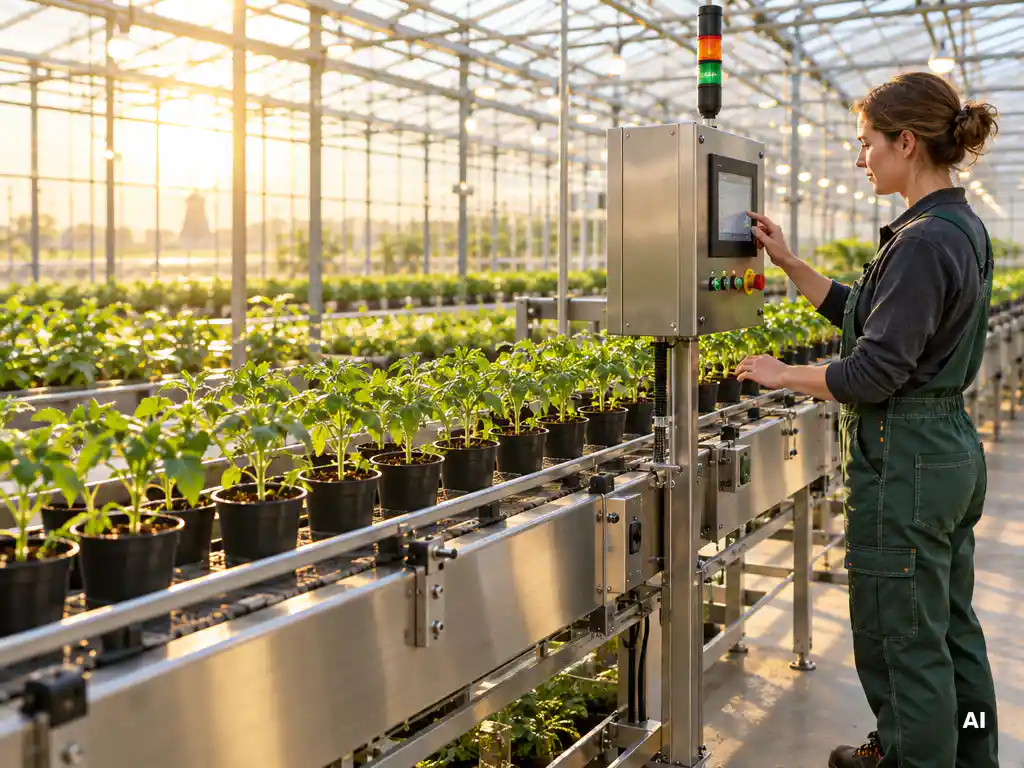
When hardware and software are designed together, machines respond to each other as one line instead of a collection of separate units. Transport belts, buffer tables, and potting machines can share timing and flow, which keeps products moving without gaps or pile-ups.
Consider a simple example. A buffer table that knows when the downstream line is ready can release products at exactly the right pace. Add a work table with a scale and lighting, and the same line supports sorting, weighing, and packing without separate systems to configure. Because these components are made to be combined, extending the line later is a matter of adding a module rather than rebuilding the logic.
This is also where labor savings become tangible. A well-matched line needs fewer people to feed, monitor, and correct it. We build our machines in our own workshop in De Lier, so the way they behave and the way they are controlled come from the same team and the same thinking. That is a large part of why we have seen customers produce the same output with far fewer people on the floor.
Fewer Handoffs, Faster Troubleshooting and Support
With a single supplier, a problem has one owner. Instead of working out whether a fault sits in the machine, the control logic, or the installation, you make one call and the same team investigates all three.
That speed matters most during peak periods, when an hour of downtime can ripple through an entire day’s schedule. A supplier who knows the hardware and software intimately can often narrow down a cause quickly, because there is no gap in knowledge between the parties involved. Spare parts, adjustments, and updates also follow one clear route.
What a single point of contact changes
Fewer handoffs also mean less repeated explanation. You describe your situation once, and that context stays with the people who support you. Over time, a supplier that has seen your layout, your crops, and your routines can suggest improvements before small annoyances turn into real bottlenecks.
Scaling Step by Step With One Partner
Starting small is easier when the first step already fits the final picture. A mobile conveyor can be a low-risk entry point, giving a team a chance to see how automation changes their day before committing to fixed installations.
From there, growth can follow your own pace. Many growers begin by renting equipment during a busy period, then move to permanent systems once the benefits are clear. Because everything comes from one partner, each new addition, whether a transport belt or a larger fixed line, connects to what is already in place instead of forcing a redesign.
This approach also protects your budget and your planning. You invest in stages, learn from each one, and avoid the risk of buying a large system that does not suit how your nursery actually works. For family businesses watching their margins, that gradual path often feels far more comfortable than one big leap.
Questions to Ask Before Choosing a Supplier
The right supplier can show how their hardware, software, and installation fit together, and can explain who is responsible when something goes wrong. A few focused questions quickly reveal how integrated an offer really is.
- Who designs and builds the machines? In-house production usually means better control over quality and faster adjustments.
- Does the same team handle software and installation? One accountable party is simpler than three.
- Can I start small and expand later? Look for options like rental or mobile equipment as an entry point.
- How do components combine? Ask whether work tables, scales, and lighting can be added to an existing line.
- What happens when there is a fault? Find out who you call and how quickly support responds.
- Do they understand horticulture? Experience with greenhouses and nurseries means fewer surprises on the shop floor.
Asking these questions before signing anything helps you compare offers on more than price. If you would like to talk through your own situation, get in touch with our team and we will think it through with you, from a first mobile belt to a fully automated line. Better greenhouse efficiency in 2026 often starts with a simpler setup, not a bigger one.
Frequently Asked Questions
How do I start moving from a multi-vendor setup to a single-supplier approach without disrupting production?
Start by mapping your current line and noting where handoffs between suppliers cause delays or manual workarounds. Then replace or add one section at a time, ideally outside peak season, choosing a partner whose new modules connect to your existing equipment. A mobile conveyor or rental unit is a low-risk way to test the approach before committing to fixed installations.
What if my existing equipment is from different brands and can't be fully replaced right away?
You don’t need to replace everything at once. Ask a potential supplier to review your current line and identify which interfaces cause the most friction, such as timing between a potting machine and a transport belt. Often, replacing the weakest links first and adding compatible modules over time gives most of the efficiency gain while spreading the investment.
How can I estimate the labor savings I could expect from an integrated line?
Begin by counting how many people currently feed, monitor, sort, and correct your line during a typical production day, and how much time goes to fixing mismatches or waiting for products. Ask the supplier for reference cases from nurseries with similar crops and volumes. A trial with a mobile or rented conveyor during a busy period can give you real numbers from your own operation.
What are common mistakes when choosing a hardware and software supplier for a greenhouse?
The most frequent mistakes are comparing offers on price alone, not clarifying who is responsible when a fault occurs, and buying a large system before testing how it fits daily routines. Another is overlooking future expansion, so the first purchase can’t be extended without rebuilding. Use the supplier questions in the post as a checklist and ask for written answers.
Is a single supplier always the better choice for a nursery?
Not necessarily in every case. A single supplier works best when they build the machines themselves, understand horticulture, and offer modular expansion. If a supplier simply resells third-party components under one contract, you may still face the same interface problems, so check who actually designs, builds, and supports each part.
What should I prepare before contacting a supplier about automating my line?
Gather basic information such as your crops and pot sizes, daily or seasonal volumes, the available floor space and layout, and the tasks that take the most manual effort. Photos or a simple sketch of your greenhouse help a lot. The clearer your picture of current bottlenecks, the more specific and useful the supplier’s advice will be.
How do I keep support quick and effective during peak season?
Agree in advance on who your contact person is, how faults are reported, and what response times to expect. Keep a short log of settings, adjustments, and recurring issues so the supplier doesn’t need to start from scratch each time. Scheduling a check of your line before the busy period also helps prevent avoidable downtime.