
Can you rent a conveyor belt for a horticulture operation?
For many horticulture businesses, internal transport is one of the biggest daily bottlenecks. Plants need to move constantly, staff walk endless kilometres per shift, and production lines stall when the flow breaks down. A conveyor belt for horticulture can solve all of that, but committing to a purchase is not always the right first step. Rental offers a practical, lower-risk route, and more suppliers are making it available than ever before.
Whether you manage a nursery, a packaging centre, or a distribution facility, the questions below cover everything you need to know about renting a conveyor belt for horticulture operations, from what is available to how to choose the right supplier.
Can you rent a conveyor belt for horticulture?
Yes, you can rent a conveyor belt specifically designed for horticulture use. Specialist suppliers offer short- and long-term rental arrangements for mobile and fixed conveyor systems built to handle the conditions found in greenhouses, nurseries, and processing lines. Rental gives you access to professional-grade equipment without the upfront capital investment of a purchase.
This option is particularly well suited to the horticulture sector because production volumes fluctuate with the seasons, and not every business is ready to commit to a permanent installation. We offer rental as a deliberate, low-threshold entry point for businesses that want to experience how automated internal transport can transform their operation before making a long-term decision. It is a practical way to test the technology in your specific environment, with your team, and within your actual workflow.
What types of conveyor belts are available to rent?
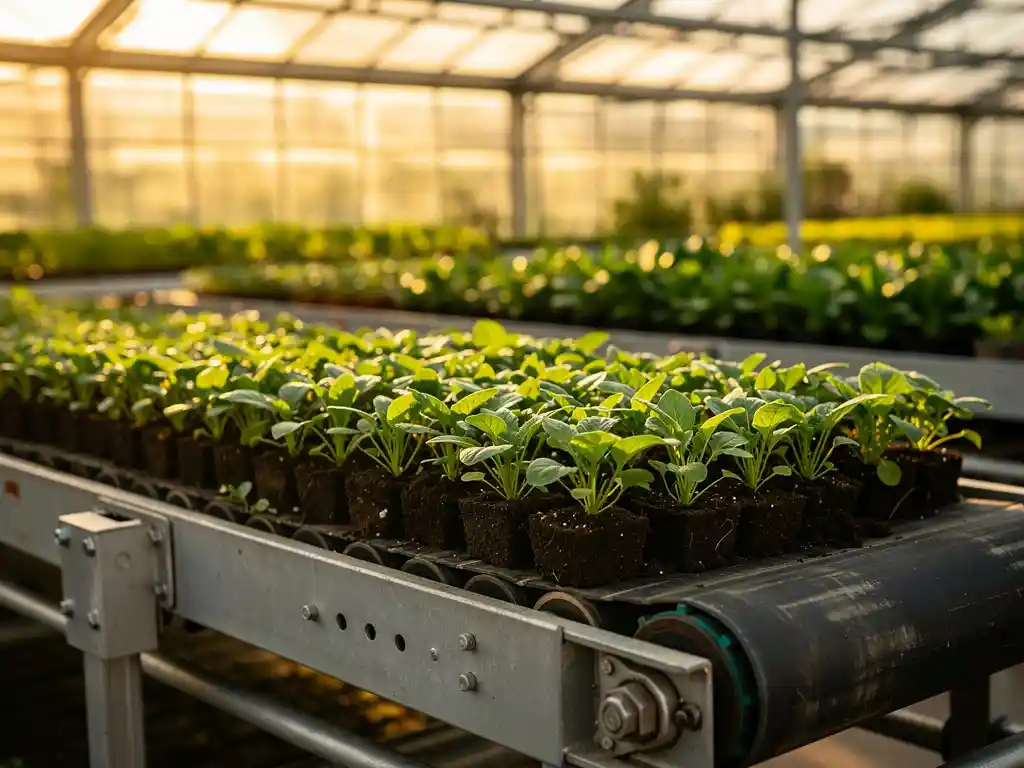
The types of conveyor belts available to rent for horticulture include mobile conveyor belts, fixed conveyor belts, buffer belts, roller conveyors, and ground-level transport belts. Mobile systems are the most commonly rented because they are flexible, quick to deploy, and easy to reposition across different areas of a greenhouse or packing hall.
Mobile conveyor belts
Mobile systems such as the EasyMax are designed to be moved between workstations or growing areas without requiring structural installation. They are ideal for businesses with variable layouts or seasonal peaks, where transport needs shift throughout the year. Because they require no fixed mounting, setup time is minimal, and disruption to existing operations is low.
Fixed and integrated systems
Fixed conveyor belts, roller conveyors, and elevator belts are also available, though these typically suit longer rental periods or trial installations ahead of a permanent project. Buffer belts are particularly useful in packaging and processing environments where regulating flow between workstations matters. All of these systems are built from robust materials that withstand moisture, soil, and the demanding conditions typical of greenhouse and distribution environments.
How does conveyor belt rental work in practice?
Conveyor belt rental for horticulture typically begins with a consultation to assess your specific transport needs, followed by delivery, installation, and commissioning by the supplier’s own technicians. You pay a rental fee for the agreed period, and the supplier remains responsible for maintenance and technical support throughout.
In practice, the process is straightforward. You describe your production layout, the type of product being transported, and the length of time you need the system. The supplier then recommends the most suitable configuration. Because horticulture conveyor systems are modular and can be combined, even a rental setup can be tailored to your floor plan. Our own technicians handle installation and commissioning, which means you do not need in-house technical expertise to get the system running. At the end of the rental period, the equipment is collected, and you are under no obligation to continue.
When does renting a conveyor belt make more sense than buying?
Renting a conveyor belt makes more sense than buying when your need is seasonal, temporary, or uncertain. It also makes sense when you want to validate the impact of automation before committing capital, or when your business is growing quickly and your layout may change within the next year or two.
Specific situations where rental is the smarter choice include:
- Seasonal peaks where you need additional transport capacity for a defined period
- Pilot projects where you want to measure efficiency gains before investing in a permanent system
- Businesses that are relocating or expanding and cannot yet finalise their floor layout
- Operations replacing broken equipment while a permanent solution is being configured
- Companies that prefer to keep capital expenditure off the balance sheet
Buying becomes the better option once your layout is stable, your volumes are consistent, and you have confirmed that automated internal transport delivers the return you expected. Many businesses start with a rental arrangement and move to a purchase or long-term project once they have seen the results firsthand. That progression is entirely natural and something we actively support.
What should you look for in a horticulture conveyor belt supplier?
The most important qualities to look for in a horticulture conveyor belt supplier are sector-specific expertise, in-house production, and end-to-end service capability. A supplier who genuinely understands greenhouse and nursery environments will deliver a system that performs reliably, not a repurposed industrial product that struggles with moisture, soil, and biological matter.
Beyond technical fit, consider the following when evaluating a supplier:
- Purpose-built equipment: Systems designed from the ground up for horticulture outperform adapted industrial alternatives in durability and suitability
- In-house production and engineering: Suppliers who manufacture in-house can tailor systems precisely to your operation and respond faster when adjustments are needed
- Installation and service by the supplier’s own technicians: Outsourced installation often leads to accountability gaps; in-house technicians mean consistent quality and faster response times
- Modular and combinable systems: The ability to expand or reconfigure your setup as your business grows protects your investment over time
- Rental availability: A supplier who offers rental demonstrates confidence in their product and commitment to long-term customer relationships
- Proven track record in your sector: Experience in ornamental horticulture, fruit and vegetable processing, or distribution centres is not interchangeable
With more than three decades of experience in automating internal transport for the horticulture sector, we understand the specific pressures that production managers and technical directors face every day. Choosing a supplier who shares that understanding is not a small detail. It is the difference between a system that integrates seamlessly into your operation and one that creates new problems while solving old ones.
Frequently Asked Questions
How long does it typically take to get a rental conveyor belt up and running in my facility?
Most rental installations can be completed within a single working day, particularly for mobile systems like the EasyMax that require no structural mounting. Fixed or more complex configurations may take slightly longer, but because the supplier's own technicians handle delivery, installation, and commissioning, your team does not need to be involved in the technical setup. In most cases, your operation can be running on the new system the same day it arrives.
What happens if the conveyor belt breaks down or underperforms during the rental period?
When you rent from a specialist horticulture supplier, maintenance and technical support remain the supplier's responsibility for the entire rental period. This means that if the system breaks down or does not perform as expected, you contact the supplier directly and their technicians resolve the issue — you are not left troubleshooting on your own. This is one of the key practical advantages of renting over buying, especially for businesses without in-house technical maintenance teams.
Can a rental conveyor system be customised or extended to fit my specific floor layout?
Yes. Because horticulture conveyor systems are modular and combinable, even a rental configuration can be tailored to your production floor. You can specify the length, height, belt width, and connection points to match your existing workflow and workspace dimensions. If your needs change mid-rental — for example, if you expand into an adjacent area during a peak season — a good supplier will be able to adjust the configuration accordingly.
Is there a minimum rental period, and what happens at the end of the agreement?
Minimum rental periods vary by supplier, but short-term arrangements of just a few weeks are commonly available, making rental viable even for brief seasonal peaks. At the end of the agreed period, the supplier collects the equipment and you are under no obligation to continue or purchase. If the rental has demonstrated clear value for your operation, many businesses choose to extend the agreement, transition to a long-term rental, or begin a conversation about a permanent installation.
How do I calculate whether a rental conveyor belt will actually save money compared to manual transport?
The clearest way to measure the return is to track the number of staff hours currently spent on internal transport per shift, then compare that figure against your rental cost and any reduction in labour hours after installation. Secondary gains — such as fewer product handling errors, reduced physical strain on staff, and faster throughput on the production line — are harder to quantify but often contribute significantly to the overall return. Many businesses find that even a short rental period generates enough measurable data to build a compelling internal business case for a permanent system.
What types of products and containers can horticulture conveyor belts handle during a rental period?
Horticulture conveyor systems designed for rental are built to handle a wide range of products and containers, including potted plants, trays, crates, cut flowers, and loose produce. The belt material, speed, and configuration can be matched to the specific product type to prevent damage during transport. If you are handling delicate or high-value plants, it is worth discussing this with your supplier during the consultation phase so the correct belt type and speed settings are specified from the start.
What are the most common mistakes businesses make when renting a conveyor belt for the first time?
The most common mistake is underestimating the length of conveyor needed to connect the relevant workstations effectively, which results in a system that only partially solves the transport bottleneck. A close second is renting without first mapping the production flow, which can lead to a configuration that creates new congestion points rather than eliminating them. Working through a proper consultation with your supplier before delivery — sharing your floor plan, product types, and peak throughput figures — avoids both of these pitfalls and ensures the rental delivers its full potential from day one.
Related Articles
- How do you compare manual labor productivity with machine output?
- What causes uneven soil density when filling pots by hand?
- How do you reduce physical strain on staff during potting season?
- Is renting a potting machine a smart option before buying one?
- How do you scale up internal transport as a nursery grows?