
What is the difference between a conveyor belt and a roller conveyor in horticulture?
When you are setting up or upgrading your internal transport system, choosing the right equipment makes a real difference to your day-to-day operations. Two of the most common options in horticulture are conveyor belts and roller conveyors. While both move products from A to B, they work in fundamentally different ways. Understanding which system suits your specific situation can save you time, money, and a lot of frustration on the production floor.
This guide answers the most common questions growers, packers, and logistics managers ask when comparing these two transport solutions in a greenhouse or distribution centre context. Whether you are handling potted plants, trays, crates, or loose produce, the answers below will help you make a well-informed decision.
What is a conveyor belt in horticulture?
A conveyor belt in horticulture is a continuous loop of flexible belt material driven by motorised rollers, used to transport plants, pots, trays, or harvested produce along a fixed or mobile path. The belt provides a smooth, consistent surface that moves products gently and reliably, making it suitable for fragile or irregularly shaped items found in greenhouse and nursery environments.
In practice, conveyor belts are the backbone of most modern greenhouse transport lines. They can be configured as straight runs, inclined sections, or curved layouts, depending on your facility. In the horticulture sector specifically, belts need to withstand moisture, soil, and the physical demands of continuous use, which is why purpose-built systems designed for greenhouses perform significantly better than repurposed industrial alternatives.
Conveyor belts also come in mobile variants, which are particularly popular in nurseries where production layouts change with the seasons. A mobile belt can be repositioned quickly, giving you flexibility without requiring a full infrastructure overhaul. Fixed belt systems, on the other hand, form the foundation of permanent production and packaging lines where throughput and consistency are the priority.
What is a roller conveyor, and how does it work?
A roller conveyor is a transport system made up of a series of parallel cylindrical rollers mounted in a frame, over which products slide or roll forward. Movement is either gravity-driven on a slight incline or powered by a motor connected to the rollers. Products must have a firm, flat base to make consistent contact with the rollers and move smoothly along the track.
In horticulture, roller conveyors are commonly used for moving crates, boxes, trays, and other rigid containers through sorting, packing, or storage areas. Because the rollers create a series of contact points rather than a continuous surface, they are less suited to loose or soft-bottomed products such as individual potted plants, which can tip or become unstable.
Powered roller conveyors allow for precise speed control and can be integrated with sensors and stops to create accumulation zones, where products queue up without pressure building behind them. This makes them particularly useful in distribution centres where products need to be buffered, sorted, or staged before the next step in the process.
What is the difference between a conveyor belt and a roller conveyor?
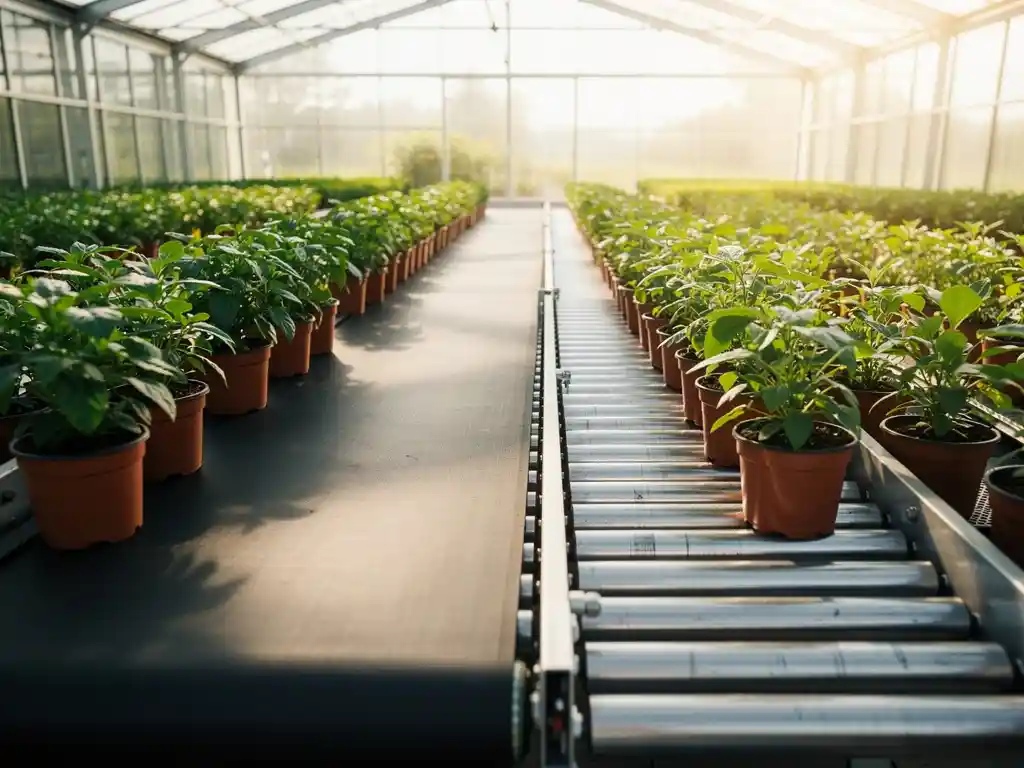
The key difference between a conveyor belt and a roller conveyor is the transport surface. A conveyor belt uses a continuous moving surface that carries products regardless of their base shape, while a roller conveyor uses individual rotating cylinders that require products to have a stable, flat base to move effectively. This distinction determines which system suits which product type.
Here is a direct comparison of the two systems across the most relevant factors for horticulture:
- Surface type: Conveyor belts offer a continuous, enclosed surface; roller conveyors offer a series of contact points with gaps between rollers.
- Product compatibility: Belts handle soft, round, or irregularly shaped items well; rollers are best for rigid, flat-bottomed containers.
- Gentle handling: Belt systems are generally gentler on delicate plants and produce; rollers can cause instability for lighter or uneven loads.
- Accumulation: Roller conveyors are better suited to creating buffer zones where products queue without damage; belt systems are better for continuous flow.
- Maintenance: Roller conveyors have individual components that can be replaced separately; belts require attention to the belt material itself and drive components.
- Flexibility: Mobile conveyor belts can be repositioned easily; most roller conveyor systems are fixed installations.
Neither system is universally superior. The right choice depends entirely on what you are transporting, how your production space is laid out, and what you need the system to do at each stage of your process.
Which transport system is better for greenhouse operations?
For most greenhouse operations, conveyor belts are the better primary transport solution because they handle the wide variety of products found in horticulture, including potted plants, trays, and loose cuttings, without requiring a uniform base shape. Their smooth surface reduces the risk of tipping or damage, and mobile belt variants offer the flexibility that seasonal production demands.
That said, the answer depends on what you are moving and at which point in your process. If your greenhouse operation includes a packing or distribution area where products are packed into crates or boxes before dispatch, roller conveyors can add real value in those downstream stages. For the growing and internal transport phases, however, belt systems are almost always the more practical choice.
Ergonomics also play an important role in this decision. Conveyor belts reduce the distance workers need to walk and the manual handling required during transport, which directly lowers physical strain and the risk of injury. In a sector where labour is both valuable and physically demanding, this benefit alone justifies the investment in a well-designed belt system.
Can conveyor belts and roller conveyors be combined in one system?
Yes, conveyor belts and roller conveyors can absolutely be combined in a single internal transport system, and in many horticulture facilities, this combination delivers the best overall result. Belt systems handle the primary transport of plants and produce through growing and processing areas, while roller sections manage the movement of crates and boxes in packing and dispatch zones.
Combining both technologies allows you to optimise each stage of your process for the specific product and task at hand. For example, a production line might use a belt conveyor to bring potted plants from the growing area to a potting or sorting station, then transition to a roller section where packed trays accumulate before being loaded onto pallets. The transition between the two system types can be engineered with transfer points or diverters to keep the flow smooth.
We design and produce both belt conveyors and roller conveyors, and our systems are built to be mutually compatible. This means a complete, integrated transport line can be assembled from a single source, with all components engineered to work together from the start rather than retrofitted later.
What should you look for in a horticulture conveyor system?
When selecting a conveyor system for horticulture, the most important factors are material durability in humid environments, compatibility with your specific products, flexibility for changing production layouts, and the ability to integrate with other equipment such as potting machines, weighing stations, and sorting systems.
Here are the key criteria to evaluate before making a decision:
- Purpose-built design: Systems designed specifically for horticulture outperform repurposed industrial equipment in wet, soil-heavy environments. Look for components that are resistant to moisture and corrosion.
- Product fit: Consider what you are transporting at each stage. Delicate plants need a continuous belt surface; rigid crates may work well on rollers.
- Fixed versus mobile: Decide whether your layout is permanent or seasonal. Mobile belt systems offer flexibility; fixed systems offer higher throughput and stability.
- Integration capability: A conveyor system that connects seamlessly with your potting machines, robots, and packaging equipment saves time and reduces manual handling at every transition point.
- Service and support: Equipment in a greenhouse runs hard and needs reliable maintenance. Choose a supplier that installs and services its own systems rather than relying on third parties.
- Scalability: Your business will grow and change. A modular system that can be extended or reconfigured is a much better long-term investment than a fixed, one-size solution.
With more than three decades of experience in horticulture automation, we understand that no two operations are identical. The right conveyor system is one that fits your specific products, your space, and your people, and that is built to keep running reliably in the demanding conditions of a modern greenhouse or distribution centre.
Frequently Asked Questions
How do I know if my current conveyor setup needs upgrading or replacing entirely?
Start by assessing whether your existing system is causing bottlenecks, product damage, or excessive downtime. If you are frequently repairing the same components, losing throughput due to layout limitations, or manually compensating for gaps in the transport line, those are clear signs that an upgrade or full replacement will pay for itself quickly. A site assessment with a specialist supplier can help you identify whether targeted improvements or a new integrated system is the more cost-effective route.
What are the most common mistakes growers make when choosing a conveyor system?
The most frequent mistake is selecting a system based on upfront cost rather than total fit for purpose, which often means choosing a general industrial conveyor rather than one purpose-built for horticulture. Another common error is underestimating how much the layout will change over time, leading to a fixed system that becomes a constraint rather than an asset. Always factor in moisture resistance, product variability, and future scalability before committing to a solution.
How much maintenance does a horticulture conveyor belt typically require?
A well-designed horticulture conveyor belt requires routine checks on belt tension, drive components, and cleanliness, typically as part of a weekly or monthly maintenance schedule depending on usage intensity. Greenhouse environments introduce moisture, soil, and plant debris that can accelerate wear if the system is not purpose-built to handle these conditions. Choosing a supplier that offers on-site servicing and stocks replacement parts locally significantly reduces downtime when maintenance is needed.
Can a conveyor system be installed without disrupting ongoing production?
In most cases, yes, particularly when the installation is planned carefully in phases or during a scheduled production break. Experienced suppliers will work with you to sequence the installation so that critical areas of the greenhouse or packing facility remain operational throughout the process. Modular systems are especially well-suited to phased installation, as sections can be added or connected incrementally without requiring a full shutdown.
Are conveyor systems suitable for smaller nurseries, or are they only cost-effective at scale?
Conveyor systems are genuinely beneficial at a range of scales, not just for large operations. Even in smaller nurseries, a well-placed mobile belt conveyor can significantly reduce walking distances, lower physical strain on staff, and improve the consistency of plant handling. The key is matching the system size and configuration to your actual throughput needs rather than over-investing in capacity you do not yet require, which is where modular and mobile options offer particular value.
What happens if my product range changes significantly after I have installed a conveyor system?
This is exactly why scalability and modularity should be high on your checklist when selecting a system. A modular conveyor setup can be reconfigured, extended, or partially replaced to accommodate new product types, tray sizes, or production flows without starting from scratch. If you anticipate significant changes to your product range, discuss this with your supplier upfront so the system is designed with that flexibility built in from day one.
How do I get started with specifying the right conveyor system for my facility?
The best starting point is a detailed review of your current workflow, including what products you are moving, at which stages, over what distances, and where the bottlenecks or manual handling pain points currently exist. Bring this information to a specialist supplier who can conduct a site visit and translate your operational needs into a concrete system specification. Avoid specifying equipment in isolation; a conveyor system delivers the most value when it is designed as part of your broader production and logistics flow.
Related Articles
- How do order volumes determine the potting machine capacity you need?
- How does changing pot formats affect hourly production planning?
- How do you train staff to operate a new potting machine quickly?
- When does manual potting become too slow for your nursery?
- How does a potting machine fill pots consistently every time?