
What is the role of automation in modern horticulture?
Horticulture is changing fast. Rising labor costs, shrinking workforces, and growing demand for consistent quality are pushing greenhouse operators and packing centers to rethink how they move products through their facilities. Automation is no longer a luxury reserved for large-scale operations—it is becoming a practical necessity for any business that wants to stay competitive. Understanding where automation fits in modern horticulture starts with the basics.
Whether you grow ornamental plants, vegetables, or fruit, the principles are the same: less manual handling means fewer errors, less physical strain on workers, and faster throughput. A horticulture conveyor belt setup is often the first and most impactful step on that journey. This article walks through the key questions growers and operations managers are asking right now.
What is automation in modern horticulture?
Automation in modern horticulture is the use of machines and integrated systems to perform tasks that were previously done by hand—including transporting, potting, sorting, weighing, and processing plants or produce. It covers everything from a single conveyor belt replacing a manual carry line to a fully integrated production system that combines multiple machines.
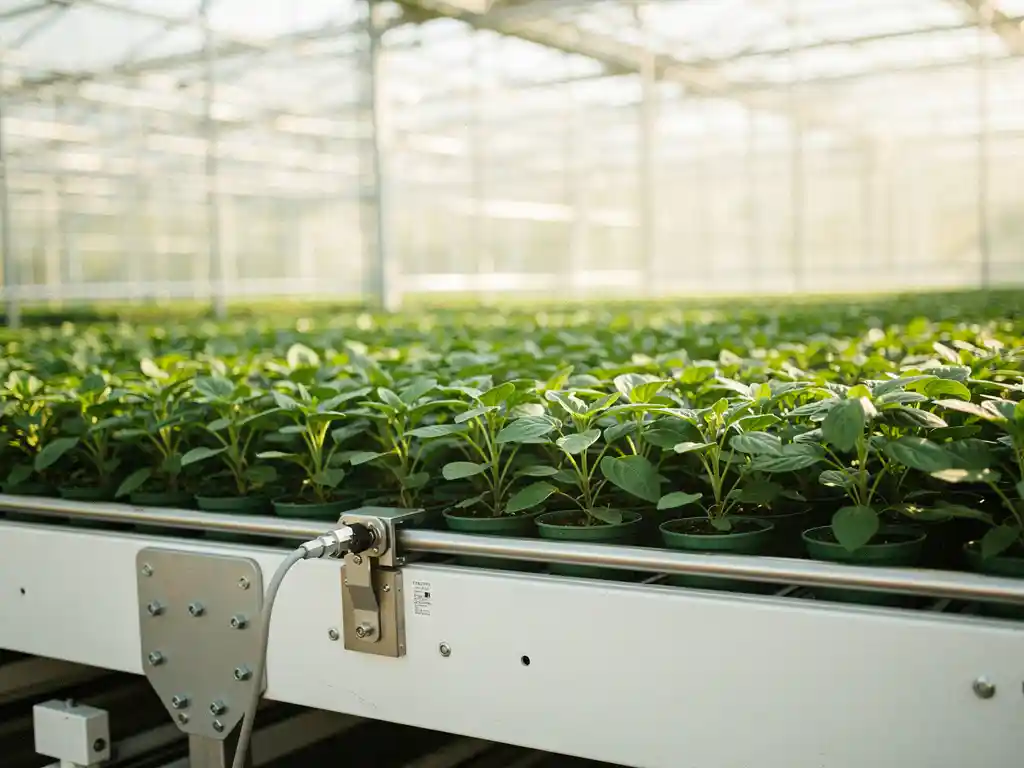
In practical terms, automation in a greenhouse or packing center means plants travel along conveyor belts rather than being carried by workers, potting machines fill and place pots without manual scooping, and buffer tables absorb natural differences in rhythm between workstations. The goal is not to eliminate people entirely but to support them—reducing physically demanding, repetitive tasks so staff can focus on skilled work such as quality control, planting, and plant care.
Modern horticulture automation also includes integrating these systems with one another. A conveyor belt connects to a potting machine, which connects to a sorting line, which feeds into a packing station. When these components work together seamlessly, the entire production flow becomes faster and more predictable.
Why is automation becoming essential in horticulture?
Automation is becoming essential in horticulture because the industry faces a structural labor shortage, rising wage costs, and increasing rates of workplace injury. Manual internal transport—carrying trays, moving pots, walking repetitive routes—is time-consuming, physically demanding, and difficult to scale. Businesses that rely on manual labor alone are finding it harder to maintain output and attract staff.
Workers in traditional greenhouse operations can walk several kilometers per shift simply moving plants from one station to another. This leads to fatigue, musculoskeletal complaints, and higher absenteeism over time. Beyond the human cost, it also represents a significant productivity loss. Every hour spent on manual transport is an hour not spent on skilled growing or quality tasks.
There is also a competitive dimension. Growers who automate can process more volume with the same headcount, respond faster to seasonal peaks, and deliver more consistent quality. In a market where margins are tight and customer expectations are high, that operational advantage compounds over time.
How does internal transport automation work in a greenhouse?
Internal transport automation in a greenhouse works by replacing manual carrying and walking routes with a connected system of conveyor belts, roller tracks, and buffer tables that move plants or products from one workstation to the next. Workers stay at their stations while the product comes to them, eliminating the need to walk the length of the greenhouse repeatedly.
The system is typically designed around the specific layout of the facility. A conveyor belt picks up plants or trays at one point—for example, after potting—and carries them to the next stage, such as a growing area, packing station, or loading dock. Buffer tables between stations absorb speed differences, preventing bottlenecks when one station temporarily works faster or slower than another.
What role do buffer tables play?
Buffer tables act as a flexible reservoir between two workstations. When one station pauses or slows down, the buffer accumulates product rather than forcing the upstream station to stop. This smooths out natural variation in work pace and keeps the overall line moving efficiently. In busy greenhouse operations, buffers are often the difference between a flowing production line and a frustrating stop-start process.
How are systems adapted to greenhouse conditions?
Greenhouse environments are demanding—high humidity, soil contamination, and constant water exposure can quickly degrade standard industrial equipment. Automation systems designed specifically for horticulture use materials and coatings that resist these conditions. This is a critical distinction: equipment built for general industry often fails prematurely in a greenhouse setting, whereas purpose-built horticultural systems are engineered to handle these conditions from the start.
What types of automation systems are used in horticulture?
The most common automation systems used in horticulture include conveyor belts, roller tracks, buffer tables, potting machines, elevator belts, and ground transport belts. Each serves a specific function in the production or distribution process, and they are most effective when combined into an integrated transport line.
- Conveyor belts: Move plants, pots, or trays horizontally between workstations. Available in mobile and fixed versions.
- Roller tracks: Low-friction surfaces that allow products to roll smoothly along a line, often used in packing and distribution centers.
- Buffer tables: Create a temporary holding zone between stations to absorb pace differences and prevent bottlenecks.
- Elevator belts: Transport products between different height levels within a facility, connecting ground-level work to raised benches or mezzanine floors.
- Ground transport belts: Move growing substrate or soil in bulk, reducing the need for manual shoveling or wheelbarrow transport.
- Potting machines: Automate the filling and placement of pots, often integrated directly with a conveyor line.
We produce all of these system types in our own workshop, and because every component is designed to work together, building a complete, efficient production line from a single supplier is entirely achievable. Systems can also be expanded over time as a business grows.
What’s the difference between fixed and mobile conveyor systems?
Fixed conveyor systems are permanently installed in a set position within a facility, while mobile conveyor systems are freestanding units that can be repositioned as needed. Fixed systems suit operations with a consistent, predictable production layout. Mobile systems are better suited to businesses that need flexibility—for example, seasonal growers or companies that frequently reconfigure their workspace.
A fixed system typically offers higher throughput and can be more precisely integrated with other machines. Once installed, it becomes part of the facility’s permanent infrastructure, and the layout is optimized around it. This works well for large-scale operations with stable, year-round production.
Mobile systems, such as the EasyMax and Wevab that we manufacture, give smaller or more variable operations the ability to deploy transport capacity where it is needed most on any given day. They require no permanent installation, can be moved between greenhouses or departments, and represent a lower initial investment. For businesses that are new to automation or uncertain about committing to a fixed layout, mobile systems offer a practical, lower-risk starting point.
How can horticulture businesses get started with automation?
Horticulture businesses can get started with automation by identifying the single biggest bottleneck in their current production flow and addressing it with one well-chosen system. Starting small—with a mobile conveyor belt or a buffer table at a key workstation—delivers immediate results and builds confidence before committing to a larger integrated system.
A useful first step is to map out how products currently move through your facility. Where do workers walk the most? Where do queues form? Where do people perform the most physically repetitive tasks? These pinch points are the highest-value targets for automation. Solving even one of them can produce a measurable improvement in throughput and a reduction in physical strain.
For businesses that want to test automation before purchasing, renting is a practical option. We offer rental arrangements that allow operations to trial a horticulture conveyor belt setup in their own facility, with real production volumes, before making a long-term investment decision. This removes much of the uncertainty that often delays automation projects.
When you are ready to scale, working with a specialist who understands the specific demands of greenhouse and packing center environments makes a significant difference. Designing a system that fits your layout, integrates with your existing equipment, and is maintained by people who know the machinery inside out is the foundation of a successful automation project—and the kind of long-term partnership that pays off year after year.
Frequently Asked Questions
How much does it typically cost to automate a greenhouse operation, and is it worth the investment?
The cost varies widely depending on the scale and complexity of the system—a single mobile conveyor belt represents a much smaller investment than a fully integrated fixed production line. The return on investment is typically measured in reduced labor hours, lower absenteeism, and higher throughput, and many operations see payback within one to three years. A practical way to assess the financial case is to calculate the current cost of manual internal transport in your facility—staff hours, injury-related absences, and lost productivity—and compare that against the cost of the automation solution being considered. Renting before buying is also a low-risk way to validate the numbers with your own production data.
Can automation systems be integrated with our existing equipment, or do we need to replace everything?
In most cases, automation systems can be designed to work alongside existing equipment rather than replacing it entirely. A conveyor belt or buffer table can be introduced at a specific point in your current workflow without overhauling the whole facility. The key is working with a specialist who can assess your existing layout and identify integration points that deliver the most value with the least disruption. A phased approach—adding one system at a time—is common and allows your team to adapt gradually while keeping production running.
How do I know which type of conveyor system—fixed or mobile—is right for my operation?
The right choice depends primarily on how consistent and predictable your production layout is throughout the year. If you run the same production cycle year-round from a stable facility, a fixed system will deliver higher throughput and a tighter integration with other machines. If your production volumes shift seasonally, you work across multiple spaces, or you want to trial automation before committing to a permanent setup, mobile systems offer the flexibility and lower upfront cost that make more sense. Many businesses start with mobile systems and transition to fixed installations as their confidence and production volumes grow.
What maintenance is required to keep horticulture conveyor systems running reliably?
Purpose-built horticultural conveyor systems are designed to withstand the wet, dirty, and humid conditions of greenhouse environments, which reduces the frequency of maintenance compared to standard industrial equipment. That said, regular cleaning, periodic inspection of belts and drive components, and prompt attention to any unusual noise or wear are important habits. Working with a supplier who manufactures their own systems and offers ongoing service support is a significant advantage—they understand the machinery at a component level and can supply spare parts quickly, minimising downtime during critical production periods.
Will my workers need specialist training to operate automated conveyor systems?
Most horticulture conveyor and transport systems are designed to be intuitive and require minimal training to operate day-to-day. Workers typically need a short onboarding session to understand start-up procedures, speed adjustments, and basic troubleshooting. The more important shift is organisational: staff roles evolve from manual transport tasks toward quality control, planting, and supervision, which is generally a positive change for employee satisfaction and retention. A good supplier will provide hands-on training at installation and should be reachable for follow-up support as your team builds familiarity with the system.
What happens if the conveyor system breaks down during a busy production period?
This is one of the most common concerns for growers considering automation, and it is a valid one. The risk is best managed by choosing systems built specifically for horticultural environments, which are less likely to fail due to moisture or contamination. Having a service agreement with your supplier that guarantees fast response times and spare parts availability is equally important. Mobile conveyor systems offer an additional safety net—if one unit needs servicing, it can often be temporarily replaced or bypassed while repairs are carried out, keeping production moving.
Can a small or medium-sized greenhouse operation realistically benefit from automation, or is it only viable at large scale?
Automation is increasingly accessible and practical for small and medium-sized operations, particularly with the availability of mobile systems and rental options that lower the barrier to entry. Even a single conveyor belt at the right point in a workflow can eliminate a significant amount of daily manual handling and free up staff for higher-value tasks. The key is not the size of the operation but the identification of a genuine bottleneck—if manual transport is slowing you down or wearing out your team, automation will deliver a measurable benefit regardless of overall scale.
Related Articles
- How do you calculate the required potting capacity for peak season?
- How many employees do you need around a high-capacity potting machine?
- How much additional production can you achieve by increasing output by 1,000 pots per hour?
- Why do some potting machines struggle with heavy soil mixes?
- What is the difference between a fixed and mobile conveyor belt in horticulture?