
What should you look for in a conveyor belt for horticulture?
Choosing the right conveyor belt for horticulture is one of those decisions that looks straightforward on the surface but quickly reveals layers of complexity once you start digging in. The wrong choice can mean costly downtime, frustrated staff, and equipment that simply does not hold up in the demanding conditions of a greenhouse or packing centre. Getting it right, on the other hand, transforms how your entire operation flows.
Whether you are managing a large-scale nursery, running a distribution centre, or overseeing a vegetable and fruit processing line, understanding what makes a conveyor belt for horticulture genuinely fit for purpose is the first step towards smarter internal transport. This guide walks you through the most important questions growers and operations managers ask before making that investment.
What is a conveyor belt system in horticulture?
A conveyor belt system in horticulture is a mechanised transport solution designed to move plants, pots, trays, crates, or harvested produce from one point in a production or processing facility to another. Unlike general industrial conveyor systems, horticultural conveyor belts are engineered specifically to handle the biological, spatial, and environmental demands of greenhouse and packing operations.
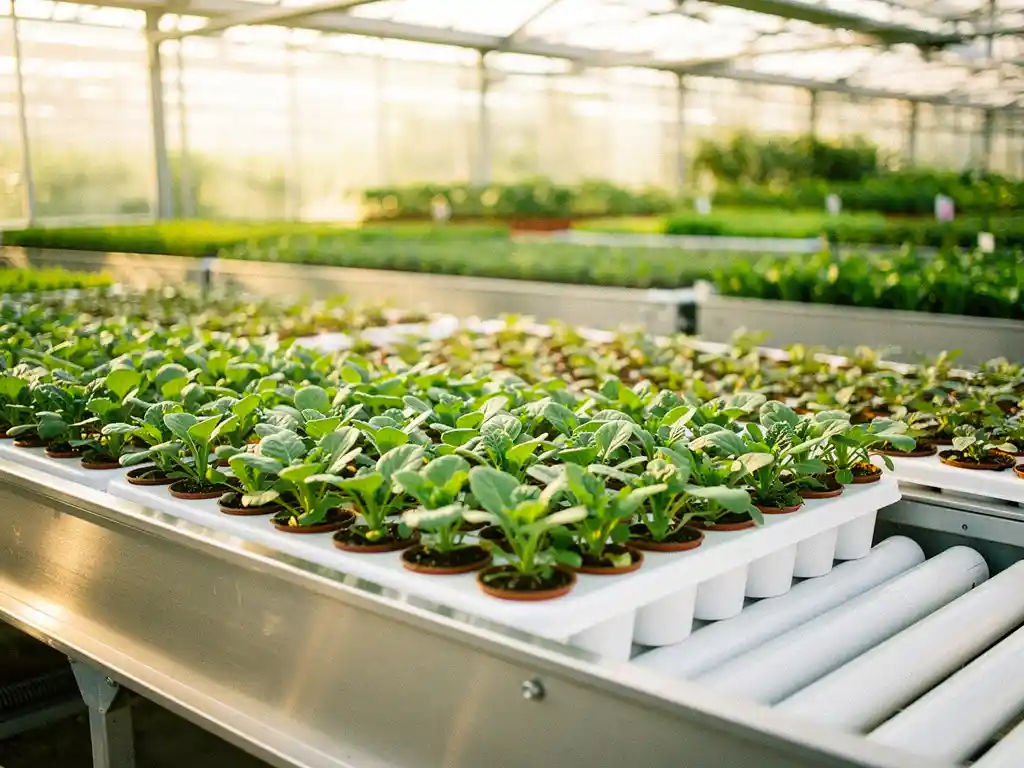
These systems can range from a single mobile belt used to move potted plants along a cultivation row to complex fixed installations that link potting machines, sorting lines, buffer tables, and packaging stations into one continuous flow. The key distinction is that a horticultural conveyor system is not simply an industrial product adapted for a greenhouse; it is purpose-built to cope with moisture, soil, irregular load shapes, and the tight spatial constraints typical of a growing facility.
Components commonly found in a horticultural conveyor system include flat transport belts, roller conveyors, elevator belts, buffer belts, and ground belts. Each plays a specific role in keeping products moving smoothly and reducing the need for manual handling at every stage of the process.
Why does internal transport matter in greenhouse operations?
Internal transport directly determines how efficiently a greenhouse or packing centre operates. When plants, pots, or harvested produce must be moved manually, workers spend a significant portion of every shift simply walking and carrying loads rather than performing skilled tasks. This creates bottlenecks, increases physical strain, and drives up labour costs without adding productive value.
The physical consequences of manual internal transport are real and measurable. Employees covering long distances per shift while carrying or pushing heavy loads face a higher risk of musculoskeletal complaints, which in turn contributes to absenteeism and high staff turnover. In a sector already facing labour shortages, this is a serious operational vulnerability.
Beyond the human cost, poor internal transport creates workflow disruptions. When one part of the process cannot keep pace with another, queues and waiting times build up across the entire line. Automating internal transport with a well-designed conveyor system removes these friction points, allowing each stage of production or processing to run at a consistent and predictable pace. The result is not just faster throughput but a fundamentally more reliable operation.
What types of conveyor belts are available for horticulture?
Horticultural conveyor belts fall into several distinct categories, each suited to different tasks and environments. The main types are mobile conveyor belts, fixed transport belts, buffer belts, roller conveyors, elevator belts, and ground belts. Understanding what each type does helps you match the right solution to the specific demands of your facility.
Mobile conveyor belts
Mobile belts are flexible, freestanding units that can be repositioned as operational needs change. They are particularly popular in nurseries and growing operations where cultivation rows are reconfigured seasonally. Models like the EasyMax are designed for easy manoeuvrability while remaining robust enough for daily intensive use.
Fixed conveyor belts and integrated systems
Fixed belts are permanently installed along a defined transport route, typically connecting key workstations such as potting machines, sorting tables, and dispatch areas. They form the backbone of automated production lines and are ideal when the layout of your facility is stable. Buffer belts play a supporting role within fixed systems, absorbing temporary surges in product flow and preventing blockages when one station runs faster or slower than another.
Roller conveyors, elevator belts, and ground belts
Roller conveyors handle crates, trays, and boxed products efficiently over longer horizontal distances. Elevator belts bridge height differences between workstations, removing the need to lift products manually between levels. Ground belts transport soil, substrate, or growing medium directly along the floor of a greenhouse, eliminating one of the most physically demanding manual tasks in a growing operation.
What should you look for in a horticulture conveyor belt?
The most important factors to evaluate when choosing a conveyor belt for horticulture are material durability in wet and soiled conditions, compatibility with your specific products, flexibility for your operational layout, ease of maintenance, and the availability of specialist support from a supplier who genuinely understands the sector.
Material durability is non-negotiable. Greenhouse environments are consistently humid, and equipment regularly comes into contact with soil, fertiliser, and water. Conveyor belts built from materials not rated for these conditions will deteriorate quickly, leading to unplanned downtime and premature replacement costs. Look for systems manufactured from components specifically selected for agricultural and horticultural use.
Compatibility with your products matters more than it might initially seem. The belt surface, speed settings, and side guides all need to suit the size, weight, and fragility of what you are transporting. A belt designed to carry heavy crates will not handle delicate young plants with the same care, and vice versa.
Finally, consider the supplier’s depth of expertise. A manufacturer that serves only the horticultural sector understands the specific challenges of your environment in a way that a general industrial supplier simply cannot. We design and produce our conveyor systems exclusively for horticulture, distribution, and vegetable and fruit processing, which means every technical decision reflects the realities of your working environment.
What’s the difference between fixed and mobile conveyor systems?
Fixed conveyor systems are permanently installed along a set route and form part of a larger, integrated production line. Mobile conveyor systems are freestanding units that can be moved, repositioned, and adapted to changing operational needs. The right choice depends on whether your layout and workflows are stable or variable.
Fixed systems deliver the highest throughput and consistency when your facility layout does not change frequently. They integrate directly with potting machines, sorting lines, and packaging stations, creating a seamless automated flow that requires minimal human intervention. The upfront investment is higher, but the long-term gains in efficiency and labour savings are substantial for operations with predictable, high-volume workflows.
Mobile systems offer a different kind of value. They suit operations where cultivation areas are rotated, where seasonal peaks demand temporary transport capacity, or where a business wants to test automation before committing to a fixed installation. For companies that are new to conveyor automation, starting with mobile units is a practical, lower-risk entry point. We also offer rental options for exactly this reason, allowing you to experience the operational benefits before making a long-term commitment.
How do you integrate a conveyor belt into an existing production line?
Integrating a conveyor belt into an existing production line starts with a detailed assessment of your current workflow, including where bottlenecks occur, what heights and distances need to be bridged, and how new equipment will connect with existing machinery. A well-planned integration improves the whole line rather than simply adding a belt to an existing problem.
The first practical step is mapping your current process from end to end. Identify where manual handling is most frequent, where product queues build up, and where workers spend the most time on non-value-adding movement. These are the points where conveyor automation will deliver the greatest return.
Next, consider compatibility with your existing equipment. Conveyor belts need to connect smoothly with potting machines, sorting tables, packaging lines, or any other stations already in place. Height alignment, belt speed synchronisation, and load transfer points all require careful engineering to avoid creating new bottlenecks while solving old ones.
Working with a supplier that handles engineering, installation, and commissioning in-house significantly reduces integration risk. When one team designs, builds, and installs the system, there is no ambiguity about responsibility if something needs adjustment during or after installation. Our engineers and technicians manage the entire process from design through to ongoing maintenance, ensuring that the system performs as intended from day one and continues to do so over the long term.
Frequently Asked Questions
How do I know whether my operation is ready for conveyor automation?
A good indicator is to track how much time your staff spend on moving products versus performing skilled tasks like potting, sorting, or quality checking. If manual transport accounts for a significant portion of each shift, or if you are regularly experiencing bottlenecks between workstations, your operation is likely ready to benefit from automation. Starting with a mobile conveyor unit or requesting a workflow assessment from a specialist supplier is a practical first step that does not require a large upfront commitment.
What maintenance does a horticultural conveyor belt typically require?
Routine maintenance for a horticultural conveyor belt generally includes regular cleaning to remove soil, substrate, and organic residue, checking belt tension and alignment, lubricating moving parts, and inspecting rollers and drive components for wear. Because greenhouse environments are wet and dirty by nature, maintenance intervals tend to be more frequent than in dry industrial settings. Choosing a supplier that offers a service contract or on-site maintenance support ensures small issues are caught before they lead to unplanned downtime.
Can conveyor belts handle delicate plants or young seedlings without causing damage?
Yes, provided the system is specified correctly for the products being transported. Belt surface material, speed settings, side guide configurations, and load transfer points all need to be matched to the fragility and dimensions of the plants or trays in question. A purpose-built horticultural conveyor supplier will be able to advise on the right combination of these factors, and in some cases can supply test runs or demonstrations to confirm that delicate products are handled without damage before installation.
What happens if my facility layout changes after a fixed conveyor system is installed?
Fixed conveyor systems can often be partially reconfigured or extended to accommodate layout changes, though this depends on the scale of the change and how the original system was engineered. For operations where layout flexibility is a long-term requirement, a modular system design or a hybrid approach combining fixed and mobile units is worth considering from the outset. Discussing future growth plans and potential layout changes with your supplier during the design phase is the best way to future-proof your investment.
Is it possible to rent a conveyor belt before committing to a permanent installation?
Yes, rental options are available and are a practical way to experience the operational benefits of conveyor automation before making a long-term investment. Renting is particularly useful during seasonal peaks when temporary additional capacity is needed, or when a business wants to evaluate how automation fits into its workflow before specifying a fixed system. It also allows staff to become familiar with the equipment, which can make the transition to a permanent installation smoother.
What are the most common mistakes operations make when choosing a conveyor belt for horticulture?
The most frequent mistake is selecting a general industrial conveyor system rather than one purpose-built for horticultural conditions, which often leads to premature wear, corrosion, and unexpected maintenance costs. Another common error is underestimating the importance of belt speed and surface compatibility with the specific products being transported, particularly when handling fragile plants or irregularly shaped items. Finally, many operations focus solely on the conveyor itself without accounting for how it will connect with existing machinery, which can create new bottlenecks rather than eliminating old ones.
How long does it typically take to install a fixed conveyor system in a greenhouse or packing centre?
Installation timelines vary depending on the complexity of the system, the size of the facility, and how much integration work is required with existing machinery. A straightforward single-line installation can often be completed within a few days, while a fully integrated multi-station system may take one to several weeks including commissioning and testing. Planning the installation during a quieter period in your production calendar and working with a supplier that manages design, installation, and commissioning as a single team will help minimise disruption to ongoing operations.
Related Articles
- How long does it take to pot 50,000 plants with a high-capacity machine?
- How do manufacturers calculate potting machine pots per hour?
- How do soil mix properties affect potting machine performance?
- How do you reduce physical strain on staff during potting season?
- How does automatic soil detection improve potting accuracy?