
Why do standard industrial conveyor belts fail in greenhouses?
Greenhouses are demanding environments, and the equipment inside them needs to match that reality. Many growers discover this the hard way when they install a standard industrial conveyor belt, only to watch it corrode, jam, or break down within months. Understanding why this happens—and what to look for instead—can save you significant time, money, and frustration.
This article answers the most common questions growers and operations managers ask when evaluating conveyor belt solutions for horticulture. Whether you are setting up a new growing facility or replacing underperforming equipment, these answers will help you make a smarter, more informed decision.
What makes greenhouse environments so hard on conveyor systems?
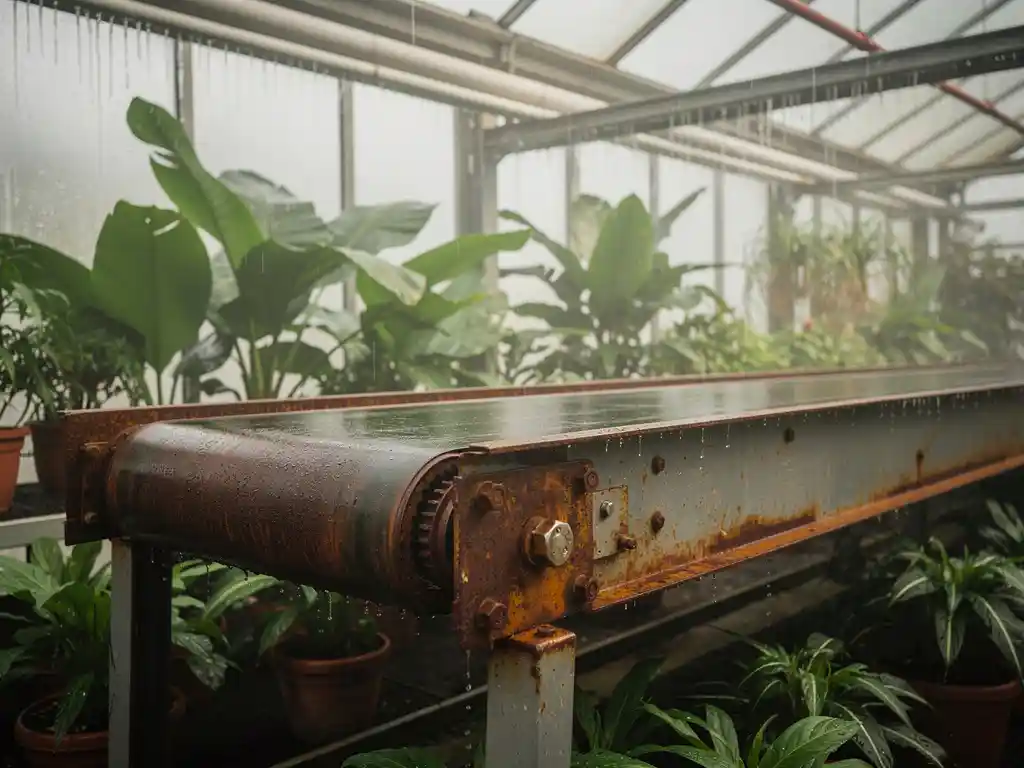
Greenhouse environments combine persistent moisture, soil contamination, temperature fluctuations, and heavy daily use in ways that no standard industrial setting replicates. This combination accelerates corrosion, degrades electrical components, and causes mechanical wear far faster than in dry factory environments. The result is frequent breakdowns, a shortened equipment lifespan, and higher maintenance costs.
The humidity inside a working greenhouse is consistently high, often sitting above 80% for extended periods. Water from irrigation systems, plant trays, and cleaning routines settles on every surface, including conveyor frames, belts, and motors. Standard industrial conveyors are typically designed for controlled indoor factory conditions, not this level of sustained moisture exposure.
Soil and growing substrate add another layer of difficulty. Fine particles from potting mixes work their way into bearings, rollers, and drive mechanisms, causing accelerated wear and blockages. Combined with fertiliser residues and organic matter, these contaminants create an environment that is genuinely hostile to equipment not specifically engineered for it.
What’s the difference between industrial and horticultural conveyor belts?
The key difference between industrial and horticultural conveyor belts lies in the materials, construction standards, and design intent. Industrial belts are built for stable, dry factory conditions. Horticultural conveyor belts are engineered from the ground up for continuous exposure to moisture, soil, plant material, and the physical demands of handling living crops without causing damage.
Materials and construction
Horticultural conveyor belts use corrosion-resistant frames, stainless steel components where necessary, and sealed bearings that can withstand regular washdowns. The belt surfaces themselves are chosen to be gentle on plant pots and trays while remaining easy to clean. Industrial belts often use materials that oxidise quickly in wet conditions and surface textures that can damage delicate plant containers.
Design intent
Purpose-built greenhouse conveyor belts are also designed with the workflow of a growing operation in mind. They accommodate the variable heights of different plant species, integrate with potting machines, sorting lines, and other horticultural equipment, and can be configured as fixed or mobile systems depending on the layout of the facility. Standard industrial conveyors offer none of this specialised flexibility.
Should you choose a fixed or mobile conveyor system for your greenhouse?
The right choice between a fixed and mobile conveyor system depends on how your greenhouse operation is structured. Fixed systems suit facilities with permanent, high-volume production lines where the workflow does not change. Mobile systems are the better choice when you need flexibility, work across multiple greenhouse sections, or want to trial automation before committing to a permanent installation.
Fixed conveyor systems deliver consistent throughput and integrate seamlessly into automated production lines. They are ideal for large-scale operations where the same tasks are performed in the same location every day. Once installed, they require minimal repositioning and can be connected to other fixed infrastructure such as potting machines or packing stations.
Mobile conveyor belts, such as the EasyMax and Wevab systems we produce, offer a different kind of value. They can be moved between growing areas as the season or crop cycle demands, require no permanent installation, and give smaller or mid-sized operations the benefits of automation without a major structural commitment. For growers who are uncertain about automation, a mobile system also provides a practical way to experience the productivity gains before investing in a fixed setup.
How do purpose-built greenhouse conveyor belts reduce labour costs?
Purpose-built conveyor belt solutions for horticulture reduce labour costs by eliminating the manual transport of plants and materials across the facility. Instead of staff walking kilometres per shift carrying trays and pots, the conveyor moves product continuously along the production line. This frees workers to focus on higher-value tasks and allows a smaller team to handle the same volume of output.
The physical demands of manual transport in greenhouses are often underestimated. Employees who spend hours carrying heavy trays or pushing trolleys across uneven floors are more prone to repetitive strain injuries, fatigue, and absenteeism. Reducing this physical burden through automation does not just cut labour hours; it also improves working conditions, which supports staff retention and reduces the indirect costs associated with injury and turnover.
There is also a throughput benefit that compounds over time. A well-designed conveyor system creates a steady, predictable flow through the production process, eliminating the bottlenecks and waiting times that occur when manual transport is the limiting factor. Faster cycle times mean more product processed per day without adding headcount.
What should you look for when buying a greenhouse conveyor belt?
When buying a conveyor belt for horticulture, prioritise moisture resistance, compatibility with your existing equipment, flexibility between fixed and mobile configurations, and access to specialist installation and service support. A conveyor that looks right on paper but cannot be properly maintained in a greenhouse environment will cost far more in the long run than a purpose-built solution.
- Moisture and corrosion resistance: Check that the frame, bearings, and drive components are rated for continuous wet conditions. Stainless steel components and sealed bearings are a strong indicator of genuine horticultural suitability.
- Compatibility with your production line: The conveyor should integrate with your potting machines, sorting equipment, and packing stations without requiring costly custom modifications.
- Fixed or mobile options: Ensure the supplier can offer both configurations, and that they understand the workflow differences between the two.
- Modular and combinable design: Systems that can be expanded or reconfigured as your operation grows offer much better long-term value than single-purpose units.
- Specialist installation and aftercare: A supplier who installs and services the equipment with their own engineers understands what can go wrong and how to prevent it. Avoid suppliers who hand off installation to third parties unfamiliar with greenhouse conditions.
- Sector experience: A supplier with decades of experience in the horticultural sector will anticipate problems that a general industrial supplier simply would not foresee.
We design and manufacture our conveyor belts specifically for the horticultural sector, which means every detail—from the choice of materials to the height of the working surface—reflects the real conditions inside a greenhouse or distribution centre. If you are evaluating options, the most important question to ask any supplier is straightforward: Was this conveyor designed for horticulture, or adapted from something else?
Frequently Asked Questions
How long should a purpose-built greenhouse conveyor belt last compared to a standard industrial one?
A purpose-built horticultural conveyor belt, properly maintained, can last 10–15 years or more in a greenhouse environment. Standard industrial conveyors adapted for greenhouse use often fail within 1–3 years due to corrosion, bearing wear, and moisture damage. The upfront cost difference between the two is almost always recovered within the first replacement cycle of the industrial alternative.
What maintenance routine should I put in place to keep my greenhouse conveyor running reliably?
At minimum, you should schedule daily visual inspections for debris buildup, weekly cleaning of belt surfaces and frames, and monthly checks on bearings, drive components, and belt tension. Purpose-built horticultural conveyors are designed to withstand washdowns, so cleaning with water and a mild detergent is generally safe and recommended. Working with your supplier to establish a preventive maintenance schedule tailored to your production volume will significantly extend the lifespan of the system.
Can a mobile conveyor system handle the same throughput as a fixed installation?
Mobile conveyor systems are highly capable and can handle substantial throughput, but they are generally better suited to variable or seasonal workflows rather than continuous high-volume production lines. For operations running a single, high-output line day after day, a fixed system will typically deliver greater efficiency and integration. However, for mid-sized growers or those working across multiple greenhouse sections, a mobile system can match practical throughput needs while offering far greater flexibility.
What are the most common mistakes growers make when choosing a greenhouse conveyor belt?
The most frequent mistake is selecting a conveyor based on price alone, without verifying that it was genuinely designed for wet, contaminated horticultural conditions. Many growers also underestimate the importance of integration — a conveyor that cannot connect cleanly with existing potting machines or packing stations creates new bottlenecks rather than solving old ones. Finally, overlooking aftercare and service support is a costly oversight; a supplier who cannot provide specialist maintenance in a greenhouse setting will leave you managing breakdowns with engineers who are unfamiliar with the environment.
How do I know if my current conveyor setup is underperforming and worth replacing?
Key warning signs include frequent unplanned downtime, visible corrosion on frames or components, recurring bearing or roller failures, and staff regularly working around the conveyor rather than with it. If your maintenance costs over the past 12 months are approaching 30–40% of the original equipment cost, replacement with a purpose-built system will almost certainly deliver a faster return. It is also worth calculating how many labour hours are still being spent on manual transport tasks that a better-configured system could eliminate.
Is it possible to expand or reconfigure a conveyor system as my greenhouse operation grows?
Yes — and this is one of the most important features to confirm before purchasing. Modular conveyor systems can be extended with additional sections, adjusted in height, or reconfigured to suit a new production layout without requiring a full replacement. When evaluating suppliers, ask specifically whether their systems use standardised components that can be added to later, and whether the same supplier can manage the expansion on-site. Locking yourself into a non-modular system early on is a common and expensive limitation as operations scale.
How do I get started with automation if I have never used a conveyor system in my greenhouse before?
The most practical first step is to map your current workflow and identify where manual transport creates the most time loss, physical strain, or production bottlenecks. From there, a mobile conveyor system is an excellent entry point — it requires no permanent installation, can be trialled in a specific area of your facility, and gives you direct experience of the productivity gains before committing to a fixed setup. Engaging a supplier with genuine horticultural sector experience from the outset ensures that the system recommended reflects the real conditions of your operation rather than a generic automation template.
Related Articles
- How long does it take to pot 25,000 plants with an automated potting machine?
- How can you identify what is limiting your potting line output?
- Why do larger nurseries switch to fully automated potting systems?
- How do soil mix properties affect potting machine performance?
- What is a potting machine and how does it work?